The Slow Club (The Song Series)

SlowClubSongSeries

The anecdote that begins this piece is one I’ve told before, time and time again actually, but for the sake of this song series I can’t possibly not include it.

It’s my mystical moment in this life.   If we only get one, then this is it.

The very first song I ever wrote, The Slow Club, which ultimately became the title cut of my debut jazz CD, is about a nightclub in Paris.  At the time I wrote it, a young thing, I’d never been to the city of lights.  A few years after writing it and performing it around town, I was singing it at an L.A. supper club one evening, and a woman came up to me afterwards. This was the exchange:


“I enjoyed your song very much.  It made me think back with the fondest of memories of my days at the Slow Club.”

“I’m sorry, I think you’re thinking of a different club … this song is fiction.  But thank you for the compliment.”

“Oh, no.  The Slow Club in Paris, France, oui?”

“I … really don’t mean to press, but I swear to you I made it up.  I’m a storyteller.  And I just sort of have this fixation for Paris.  

“And I am telling you, mademoiselle, that I’ve been to this place you sing about.   On the Rue du Rivoli, right down the way from the Louvre.  I would say that is some pretty powerful  fixation.”


My jaw was officially dropped, as I continued singing this song around town, told this story, and relished in my, and my song’s, spooky allure, even though I wasn’t completely convinced that this total stranger wasn’t merely having her fun with me.  Until I finally did make it to the city of my dreams for the first time ever, and looked up the Slow Club in my tourist guide book (this was before the internet was at everyone’s fingertips for instant information).  And there it was, with a Rue du Rivoli address, as promised.

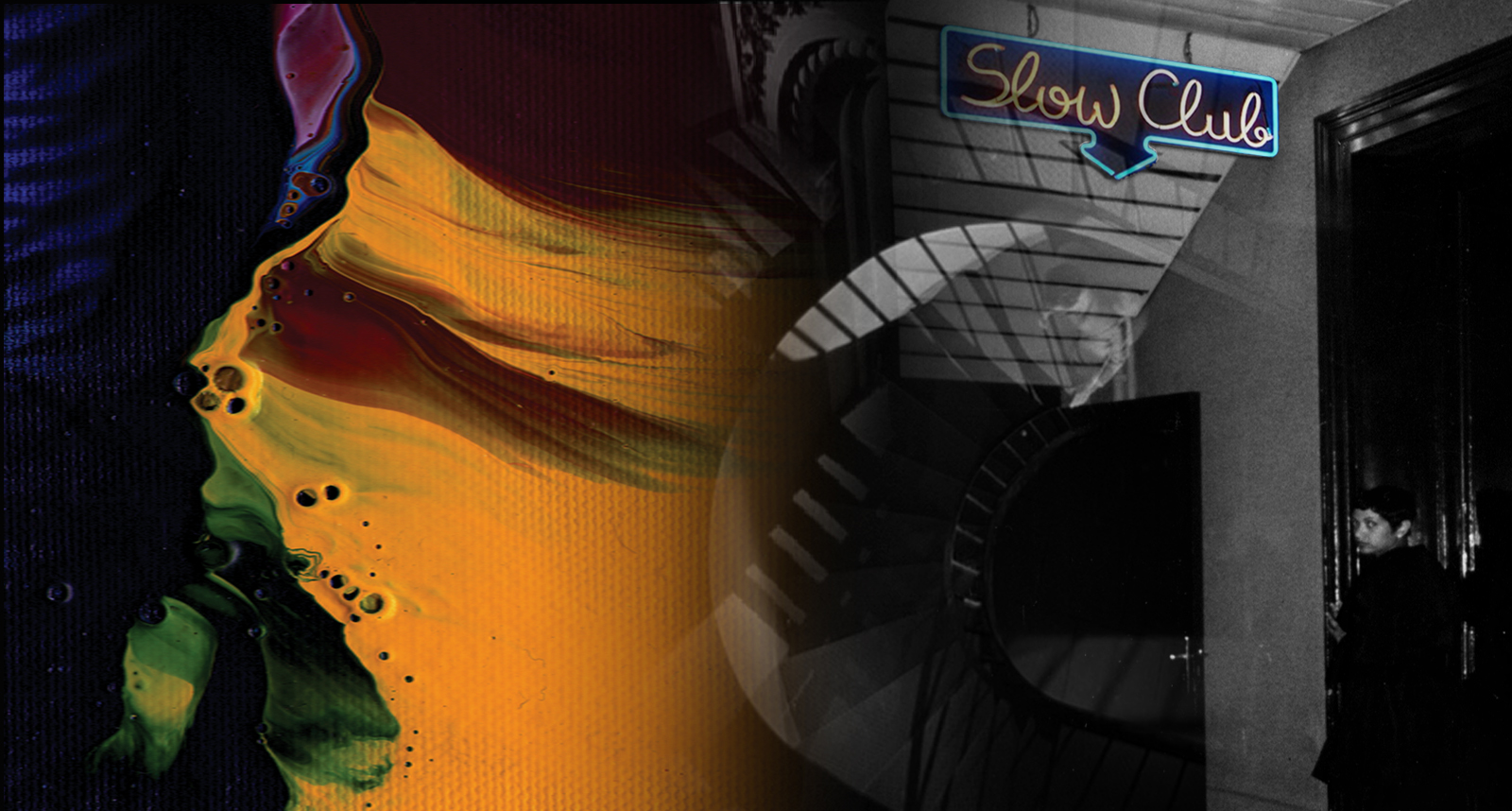
The first chance I got, I went to this place that I thought had been conjured in my head.   But the mind-freak did not stop there.  As I walked in, every single detail I describe in the lyric of the song was personified before my very eyes, from the winding staircase that takes one down into it below street level, to the smoking, blue ambiance that invited secret rendezvous on those stairs.

I promptly ordered a sloe gin (not a great-tasting cocktail, but mentioned in my lyric so I had to participate), grinned from ear to ecstatic ear at the marvels of  life, the marvels of my life, and concluded that I must’ve been that Slow Club chanteuse in another lifetime, simply recalling pockets of memory from a long-dormant nether-plane.

Now, as to whether an actual spiritual reincarnation is the explanation, or merely a mischievous flight of fancy, it was that singular experience that began my journey as a musician and a writer, carrying with me at all times the mysterious wonders that art simply begets.

I’ve had people suggest to me, upon hearing the story, that perhaps I had heard of the Slow Club, forgotten that I’d heard of it, and that it had lodged itself in my subconscious, and came up when I was ready for it.  Of course that’s possible, and I also do know how difficult it can be for people to suspend belief, to take leaps of fanciful fate.  Except that I know it did not come to me in that way.  Because the way it DID come to me is very clear in my memory.   The movie Blue Velvet, a film whose story takes place somewhere in the Midwest, features a dive called the Slow Club at which the character Dorothy Valens sings.   First off, I was 26 years old when I first saw this movie, and had just been initiated into my very first cinematic experience of heavy symbolism, metaphor, and creepy yet compelling depiction of life.  Not your garden-variety crime story – at least up that point in 1986.   I was blown away by the movie and its uneasy humor, but that’s an article for another day.  I was mesmerized by this nightclub in the movie, and fancied myself as the femme fatale Dorothy Valens.  Except that in my micro-managing fantasy, this alter-reality HAD to take place in Paris not the Midwest, for god’s sake.  There was romance and allure to Paris.  Not so much Lumberton USA.  My head lived in the Parisian clouds for just about that whole decade, praying that someday I would get there.  But yes, Blue Velvet is where I got the idea for my own Slow Club.  Not anything subconscious bubbling up, but a markedly conscious agenda to realize a noir reverie through song.

Imagine, then, my shock and awe to discover the very real place right there in the 1st Arrondissement.

Besides the Blue Velvet / Dorothy Valens fantasy as the engine for my song, there was also the fact at the time (around 1985-86) I had begun immersing myself in jazz.  An early hint of what would become a lifelong love had been given to me in teenhood, when my older sister (not even a musician!) made me listen to the likes of Pharoah Sanders and Lonnie Liston Smith, and I was hooked, even if I couldn’t make heads or tails of what exactly I was listening to.  And by the time I was in my mid-twenties, a string of boyfriends, all musicians, had been instrumental in introducing me to every facet of jazz, from the virtuoso bass playing of the Jaco’s and the Stanley Clarke’s, to the Afro-Cuban and Brazilian movements, to the progressive natures of Miles and Coltrane and Jarrett and McCoy Tyner, to the ridiculous vocalise prowess of singers like Eddie Jefferson and Lambert, Hendricks, and Ross, to all the new fusion guys, Metheny, Zawinul, McLaughlin, Corea, ad nauseum, as there’s no shortage of jazz movements and pioneers. I became as entranced by this challenging music as I had been by Parisian-chanteuse daydreams.  So when it came time to attempt my own songwriting, and all I was armed with were the years of piano lessons in childhood, I played around on the keyboard until I found luscious cluster chords that I recognized from the harmonic vocabulary I was being saturated with, but didn’t know how to name, or even how to use in the proper theoretic way.  I knew basic triads, and some bluesy 7ths.   But when it came to flat nines and sharp elevens and Lydian dominants, blah, blah, blah, I was so out of my league.  But I just kept playing around and discovering, and got the mentorship of the many musicians I was gigging with.  And it was a genuine renaissance in my life at that time as an artist, and finding my way, my legs, and eventually my own voice as a songwriter.  When I finally came up for air, The Slow Club  was composed.

The first years of singing the song around town, doing the cabaret and jazz circuits in L.A., it was a brushes-on-the-snare-variety jazz ballad.  And before the recording that is featured here came to fruition, the song saw several incarnations.  I stuck it in my one-woman show The Purple Sleep Café, where it was segued to, from a scene where a rather disastrous audition takes place, and the message of the piece being the importance of staying true as an artist.  And a singer friend who was on the same cabaret circuit as me, and loved the song and asked if he could include it in his repertoire, had a complete orchestral arrangement done of it (an arrangement I never got to hear, as he had taken his show with him to Vegas).

And then, as the years passed, and it was finally time to consider my own jazz album of originals (I’d amassed several by that point, which I’d sung around town for years), my own tastes had shifted somewhat, and I started to hear the song with a different feel.  The jazz fusion genre was enjoying yet another emergence after having been originally established in the 1960’s, and the half-time-shuffle (a rhythmic feel that was starting to be labeled hip hop, as it was used extensively in hip hop music) was a prevalent feel in a lot of what was being called jazz funk.  I liked the feel, thought it might work well with The Slow Club, which still kept the song a ballad, but now with a little hump to it; the kind that screams out for a muted trumpet.  So, by the time I was assembling the latest incarnation of players for my ongoing jazz project (circa 2003 by this point), in the form of pianist Ed Czach, bassist Jonathan Pintoff, and drummer Craig Pilo, this was the way we were playing the tune.  The only change that the composition saw, once I’d switched rhythmic gears, was that I’d added bookends of a minor chord riff into this major-chord piece.   With the addition of trumpeter Ron King, doing his muted thing, we recorded the song live in a church, and The Slow Club was from that moment forth and forever documented.

It not only became the title of the album, but eventually, by the time we had a second album as a trio, the ensemble was named The Slow Club Quartet.   Friends teased me about the band name.  Craig Pilo, the drummer in the group and our resident comedian, would often refer to us as The Very Slow Club Quartet.  But the ribbing was fine, perfectly take-able, because my own history with the song as my very first composition (my cherry-buster), and the mystical magical story that went with it, was all I needed to hold onto, to know that we couldn’t possibly have called ourselves anything else.  Not if I was helming the group.

Please enjoy The Slow Club.


Click here to listen on Bandcamp


There’s an old club in Paris on the bluer side of town
It hails on the back street underground
The lady there she sings a sad song – the jazzmen live to blow
They make a kind of music we all know – so
With a slow dance and a sloe gin
Won’t you take me to that Slow Club once again

Don’t move too fast, cuz I’m in no hurry
I’d rather take it at a Paris pace
The dark behind the neon which blinks a rhythmic tune
Rather hypnotizes every face – so
With a slow dance and a sloe gin
Won’t you take me to that Slow Club once again

Listen to those brushes fondle that old drum head
Feel mister bass man snatch your soul
Watch those piano fingers bleed into the keys
As the jazz men swing it low

o many moody face – secret meetings on the stair
“S’en allez avec moi – nous ferons la cour – mon coeur”
With a slow dance and a sloe gin
Won’t you take me to that Slow Club once again

Listen to those brushes fondle that old drum head
Feel mister bass man snatch your soul
Watch those piano fingers bleed into the keys
As the jazz men swing it low

It rather hypnotizes and it makes my old heart sting
When I listen to that slow club lady sing
With her slow dance and her sloe gin
You will see her make a friend of all the men
With a slow dance and a sloe gin
Won’t you take me to that Slow Club once again
With a slow dance and a sloe gin
The neon reads forever “come on in”


Angela Carole Brown is the author of three published books, The Assassination of Gabriel Champion, The Kidney Journals: Memoirs of a Desperate Lifesaver, and Trading Fours, and has produced several albums of music and a yoga/mindfulness CD.   Bindi Girl Chronicles is her writing blog.   Follow her on Twitter, Facebook, Instagram & YouTube.

Blue Sea of August (The Song Series)

Blue Sea of August


“ I’m a sucker for a burnished alto voice and an apocalyptic slide,
so this kinda works for me…”

– David Kelly


The first and last tracks on 2008’s Music For the Weeping Woman, which are Blue Sea of August and Bells (Of the Blue Sea), are actually the same song, but bookend the entire record with a vocal version and an instrumental rendering.  There is a bonus track, which is not available on the hard copy recording, but only as a single download, that is a marriage or mash-up of the two.  This is the recording featured here now.

Blue Sea of August  was the first song I wrote towards the album project Music For the Weeping Woman.   I had a very specific, narrow, and focused idea of what I wanted to accomplish with this album, and with the individual songs:  An ode to the vulnerability of women and their tears, and the myriad of emotional engines behind the phenomenon of tears, the seed of inspiration being Picasso’s “Weeping Women” series.  I’d just seen the movie Cold Mountain, and there is a song that plays throughout the film that was written by Sting, and sung by Alison Krauss, two of my favorite musicians, so that got my attention.   It was the most eerie and haunting ballad I think I’d ever heard, and really captured that sense of ancient folklore and American roots.   It was also such as ridiculously simple form whose simplicity was almost deceiving for how powerful it was.  I was instantly inspired to create something along similar lines.  Blue Sea of August  is about longing and loss in the most general sense of those words, but it wasn’t until I wrote the lyric “When my true love comes a-marching home” (an unexpected nod to the transpiration of the soldier) that I was really hit with the full scope of what longing and loss could encompass, and that it was potentially massive.   That’s the lyric portion of things.  When it came to the music part, it was my first time writing in a very small form, an almost (really stretching the boundaries on this) dactylic tetrameter quatrain, and allowing that to be the entire song (four stanzas of it), and resolving it without the standard pop music arrival chorus.  It’s completely rubato, and yet with that implied dactylic design.

As for the title, I took it from the 1975 Lena Wertmüller film Swept Away, whose complete title is actually Swept Away By An Unusual Destiny In the Blue Sea of August.  But the movie studio nixed the cumbersome title, and went with the shortened version for its official release. Personally, I think they kept the wrong half of the title.   And so, IN swoops Angela to happily take it off their hands.   I had no idea what kind of deep thirsting I was about to unleash as I began to compose.

Once the song was written, and in preparation for recording it, I had lots of conversations with guitarist Ken Rosser, my partner on this album, on the conceptual ideas for the song.   Of the many developments that came out of our confabs, and the incredible way in which (despite the fact that I am the sole composer) this was completely collaborative, was Ken’s idea to do, as well, an instrumental version of the song.   He had an entire layering concept in mind, and there isn’t often a bright idea of Ken’s that I say “no” to.    Once this absolute stunner was executed, and I added some Tibetan singing bowls to the proceeding, I knew it would require its own title.  Enter Bells (Of the Blue Sea).  

Fast forward to just a few months ago (roughly 6 years after the album’s release), and I decided to mash up both versions and make it available as an extended single.  I posted the track on Facebook, and got a really lovely thread going, beginning with the quotation at the top of this piece.   And while there were several participants on this thread, for the purpose of this piece I have culled only Ken’s and my contributions.  The rest were generally some pretty amazing and gracious accolades, but the process, as Ken and I excitedly recalled it, is really what I wanted to expound on here.

As transcribed from Facebook:
.
.

KEN ROSSER
This is one of my favorite tracks I’ve ever played on.


ACB
Apocalyptic slide?   Yeah, David Kelly!   That’s just about perfect.


KEN ROSSER
Just here to be of service.


ACB
I think of this song as almost a sea shanty, but without the yo-ho-ho-ness of your typical sea shanties. Instead there is a quality of looming doom in the music, much like that sense one might get from staring out at the sea, and acknowledging its ever-elusive horizon.  I wanted the feeling of a haunting, and I imparted that to Ken. So he began experimenting with loops and feedback, and this kind of grungy aural thing that almost evoked the sound of whales, or the creaking of a haunted barge (seriously!), and suddenly this unfolding of a dark abyss began to take shape.  I am a sucker for pathos, and Ken really captures that sense of loss and longing that is the prevalent intention.  And then there is the super-tremendous instrumental rendering of the song, whose textures are even thicker and darker and more perilous.  Ken gets me so well!   He is an absolute revelation on these tracks, and they remain my favorite on the album.


KEN ROSSER
Still never seen Swept Away . . . I need to fix that.


ACB
Dude!  . . . . . . . . . . .  That’s all I’ll say.


KEN ROSSER
Once you get into the emotional space of the piece it’s just a matter of framing and reinforcing.  So, because there was this tonic/dominant drone, I used an idea I’d gotten from the composer Angelo Badalamenti to add another layer of harmonic tension and release that would sort of work around that.  Then it was just coming up with those sounds, which are a pretty standard part of my vocabulary – using fuzz boxes and delays to generate layers of tones, and then sub tones and overtones.

Doing an instrumental recasting of the melody was an idea I’d heard in tons of film scores, where there’s a vocal theme song but little instrumental snippets of it reappear throughout – Breakfast At Tiffany’s (MoonRiver) and Alice In Wonderland  being two that immediately come to mind.  And I felt like since the record was basically a dialog between the guitar and voice, the guitar should get the last word.

Guitar-wise, this was me paying homage to some of my biggest influences, David Torn (whom I was becoming friends with at the time and was advising me a lot), Terje Rypdal, and Ry Cooder (especially his Trespass soundtrack).

I used a G&L Legacy for the whammy bar stuff and Larry Pogreba guitar for the slide, through Lovepedal Eternity and Wolfetone Chaos fuzz pedals and the Echoplex Digital Pro for the loops/delays, into a VHT Pittbull 45 amp.


ACB
Yeah, and I used a single index finger on the low end of the synthesizer, on the tonic for about 16 bars, and then on the dominant for about 16 bars.   Very complicated stuff on this end, Ken.   Don’t feel intimidated.


KEN ROSSER
Angela, I thought you might find this funny, as I don’t think I’d ever told you. When I did that melody instrumentally I was really trying to fixate on getting a vocal phrasing and for some reason the actual voice that popped in my head was Sinéad O’Connor’s, because I imagined that a song about the sea would work well in her Irish brogue, with this slightly angry sneer to it.  There’s even one of her little pet vocal tics that I snuck in there, that sorta cracks me up a little when I hear it now.


ACB
Sinéad O’Connor should record this song!!


KEN ROSSER
If that makes you a butt load of money, you owe me dinner.


ACB
From now on, when I listen to Bells (Of the Blue Sea) I’ll be listening for Essences of Sinéad.

So, the funny thing on MY end about your Sinéad inspirations is that I’ve always had a tug at me from the Irish when it comes to my songwriting.  (Where the hell does that even come from?  I’m a black chick from Compton!)  But if you think about Far Above Rubies, and a couple others of mine, there’s definitely an ancestral tug of some sort there.


KEN ROSSER
Yeah, it’s funny how that is.  And well, I figure – you go back far enough, we’re all from East Africa a few hundred millennia ago . . . the black American and Irish experience are just different shades of the human experience, taking the long view.


ACB
Anyway, what were we talking about?


(End of Facebook transcription).


I know that we could go on and on about this.  It was such a fun recording process for us.  But I’ll stop here, and I hope you enjoy Blue Sea of August / Bells (Of the Blue Sea).


Click here to listen on Bandcamp


There is a calm on the blue sea of August
There is a balm that anoints my head
It is the promise that my one true love
Will find me before I’m put to bed

There is a haze on the blue sea of August
There is a gaze that shines its eyes on me
It is the warning that I’d best be ready
When my true love beckons tenderly

There is a gleam on the blue sea of August
There is a dream that settles on the foam
It is that love will ne’er again falter
When my true love comes a-marching home

There is a gust on the blue sea of August
There is a lust all other seasons lack
‘Tis in the heat of a summer’s high noon
When the sea swears to bring my true love back

Angela Carole Brown is the author of three published books, The Assassination of Gabriel Champion, The Kidney Journals: Memoirs of a Desperate Lifesaver, and Trading Fours, and has produced several albums of music and a yoga/mindfulness CD.   Bindi Girl Chronicles is her writing blog.   Follow her on Twitter, Facebook, Instagram & YouTube.

Fix the Bend (The Song Series)

FixTheBend

I’ve decided to start a little songsmith series here on Bind Girl Chronicles, detailing the inspiration, inception, and creative process behind the songs that I’ve composed.   I wouldn’t, by any stretch, call myself a prolific writer. I’ve written remarkably few songs in my 3 decades as a musician.   But each one has been an undertaking that has felt meaningful, has had its mountains for sure, and hopefully translates in finished product as something meaningful for you, the listener.

And so I’ll start with Fix the Bend, a song I wrote in 1989, but didn’t feature on any public recording until 2004.

CS Lewis, in his science fiction / fantasy novel Out of the Silent Planet, called us, “us” meaning earthlings, the Bent Ones, because of his book’s assertion that we divide the beautiful forces of the world with our intolerance, ignorance, and hubris. And so from Lewis’ label “the Bent Ones” came the title for my song Fix the Bend, an ode to human beings’ struggle to find meaning through works, and through legacy.

As I began to compose, and instantly chose a 6/8 rhythmic pattern, and an “empty fifth” riff, the song seemed to find its way toward something very Africanesque.

(Geek Warning!   An empty fifth, which is also sometimes called an open fifth, is a chord with the root and fifth only, and no third.   The third determines if the chord will be major or minor, and so the absence of one makes it a chord that can fit in most any harmonic environment.  There’s an angularity and a stoicism to the empty fifth, IMO.)

And so, since it seemed to be developing in a vague sort of neo-Carribean/African way, I asked my brother-in-law, McKinley Thomas, who had spent many years living in Tanzania and therefore spoke fluent Kiswahili, if he would translate the phrase “fix the bend” for me, something to use as a kind of chant to churn beneath the bed of the song. What he came back to me with was so enigmatic sounding.

Kulekebisha Imeeda Kumbo translates roughly as to “right what is wrong” or even “repair what is broken.”   I just loved its power. I loved its ancientness.   And I loved that it had so many syllables and hard consonants!   Something I could really work with in terms of creating a chant.   That seemed to be the completing factor of this song about the human race just scrambling to give their lives meaning in a world that is growing increasingly bent.

The song was written years before I produced my album Resting on the Rock, but other than a home studio recording that was largely sequenced and synthed all out of early-90s-style proportion, it had never appeared on any record.   So, when it came time to assemble a body of material for Resting on the Rock, I pulled it off the symbolic dusty shelf, and brought it to the guitar-led trio that I was calling The Global Folk.   The Global Folk (who, on rare occasions any longer, do still come out of hiding for a special occasion), consists of  multi-stringed instrumentalist Ken Rosser, bassist Ross Wright, and drummer and ethnic percussion whiz Paul Angers.  And they brought the song to life in a very different, very organic, very folkloric way. Ken Rosser plays the electric 12-string guitar and his iconic electric sitar on the track.  Ross Wright plays the fretless bass.  Paul Angers contributes a wonderful layering of African drums, which include the tbilat, djembe, tsanatsel, and tiwa shakers.   And even I contribute a little “marimba” synth sound for flavor, playing the main empty-5th riff, and of course lead vocal.   The crowning factor, however, are the deep baritone voices of Glenn Carlos and Kellum Lewis chanting the haunting words that McKinley had given us.

I am really tickled with this song, and its treatment by the Global Folk.   One thing I really know about Ken Rosser, whom I’ve often called, in all earnestness, my musical soul mate, is his way with an electric sitar.   He plays the real gourded thing as well.  But when it comes to the electric, he has absolutely no interest in trying to replicate the acoustic sitar sound, texture, tone, even style.   He considers it a different animal altogether.   And as such, his takes on a most unexpected role in this song.   His solo, on the electric sitar, is almost blues . . . and with every bit of pathos that goes with the blues.   Very exciting for me.

I’d originally had the composition move into a brief 5/4 cadence before rushing back into the loping 6/8, which was meant to be a kind of power-trio moment, which really worked well in its original synth-y form.   But with these real instruments playing something more aligned with nature and a folk-culture stamp than with the synthetic gloss of the original conception (and that lovely, self-indulgent, time-signature-change-every-3-bars, dated, 1993 sound), the 5/4 moment really no longer had a place.  I didn’t want to lose the “spiritual zone” of the 6/8.

The song opens with just the tiniest grace note of Martin Luther King’s 1963 speech on the Lincoln steps. Seemed appropriate.

I hope you enjoy Fix the Bend.


Click here to listen on Bandcamp


men will try to give their sons the moon
boys in turn they leave their fathers soon
women fight to raise their daughters right
and they try,   and they try

 lovers pen the epic prose of spring
preachers preach the words “let freedom ring”
soldiers fight the battles they are sold
and they try,   and they try

fix the bend …

painters leave their lives on muraled walls
heroes leave their mark upon us all
live to shout that we must fix the bend
and they try,   and they try

fix the bend …
(kulekebisha imeeda kumbo)

creatures say of us from other worlds
“look see how they’ve dulled their shiny pearl”
mother earth she screams to fix the bend
we must try,   we must try

fix the bend …
(kulekebisha imeeda kumbo)

Angela Carole Brown is the author of three published books, The Assassination of Gabriel Champion, The Kidney Journals: Memoirs of a Desperate Lifesaver, and Trading Fours, and has produced several albums of music and a yoga/mindfulness CD.   Bindi Girl Chronicles is her writing blog.   Follow her on Twitter, Facebook, Instagram & YouTube.

A November Thought

Gratitude Flower

i live in gratitude

i live in gratiude

i live in gratitude

every day that i awaken and breathe

i am grateful

every day that i think a thought

and feel my heart’s stirring

i am grateful

every day that i am upright and whole

i am grateful

every day that a creative idea becomes solid matter

i am grateful

every day that i face that thing of which i am most afraid

i am grateful

every day that i am given awareness of the smallest of beauties

the most unsung of treasures

i am grateful

every day that i am enlightened

given insight

have an epiphany

i am grateful

every day that i exercise compassion

understanding

patience

i am grateful

every day that i encounter another living creature and engage

i am grateful

every day that i am hugged

kissed

loved

i am grateful

every day that i laugh

or make someone laugh

i am grateful

every day that my family is healthy and happy

i am grateful

every day that my friends do well in the world

i am grateful

every day that i change someone’s life

or someone changes mine

i am grateful

every day that love is evident in my life

i am grateful

every day that i act out of anger

impatience

frustration

a broken heart

i am grateful

for each affliction offers an opportunity

to learn about myself and my fellow man

every day that brings me a challenge that tests my spirit

i am grateful

every day that i am humbled by a mistake

i am grateful

why else do our mistakes exist?

every day that i am faced with seemingly unbearable odds

i am grateful

for the lessons learned

and the spirit toughened and strengthened by it

are more valuable to me than if i were living an effortless life

every day that i try

i am grateful

every day that i try again

i am grateful

every day that i can have some time to myself

for quiet and reflection

i am grateful

and when they ask me what’s new?

i will answer every single day

because every single day that arrives

brings a sun

a moon

a breath

a surprise

a blessing

a song

whether sung or heard

and the ear to hear it

a world of love at our fingertips

a capacity for hope

a reason to smile

and a heart full of gratitude

so when they ask me what’s new?

i will answer everything

at every single moment

and for that

i am grateful


Angela Carole Brown is the author of three published books, The Assassination of Gabriel Champion, The Kidney Journals: Memoirs of a Desperate Lifesaver, and Trading Fours, and has produced several albums of music and a yoga/mindfulness CD.   Bindi Girl Chronicles is her writing blog.

Dyslexia

FakeHeadsRealFlowers

She stared at the vast room of heads.   Antelope.  Deer.  Tigers.  Elk.  There was even an elephant’s foot, chopped right at the stump, cured or taxidermied or whatever, and then made into an end table.

She was repelled and intoxicated at the same time.  This man was made of the kind of fortune handed down, not earned.  And he seized his day in the only way men of that kind of birth-wealth know how to do it.   By covering his walls in trophies.  Bold statements about traveling the world and facing danger, and lame attempts at claims of great human triumph, like, “I wanted to see the rainforest before I died.  And by God, I’ve done it!”

The fact that he was conquering instead of paying homage seemed to be an irony lost on him.

Why couldn’t he claim worldliness and acculturation by bringing home some original Chagalls or a piece of the Great Wall?

She walked into his guest bathroom, which smelled of hotel disinfectant, and admired the floral arrangement that would’ve been too large to fit in her living room.  She leaned over to smell them and was stunned (but, really, should she have been?) that they were made of plastic.  Uncanny looking.  They even had fiberglass dewdrops on them.  Someone out there was actually the artisan of these fake flowers.   What a strange thing to claim as your medium.

“I work in oils.”

“I dabble in clay.”

“I make fake nature.”

And all she could think was how backward this man, with one of the wealthiest wine collections in the world, had gotten it.

She shook her head and muttered to herself:

“Dude, FAKE heads, REAL flowers.  Not the other way around.”


Angela Carole Brown is the author of three published books, The Assassination of Gabriel Champion, The Kidney Journals: Memoirs of a Desperate Lifesaver, and Trading Fours, and has produced several albums of music and a yoga/mindfulness CD.   Bindi Girl Chronicles is her writing blog.   Follow her on Twitter, Facebook, Instagram & YouTube.
Dear Virginia

HauntedVirginiaWoolf

Nearly twenty years ago, I was properly slapped and mesmerized by a quote of Virginia Woolf’s:
“Who can pen when he is bored?  The minds of leisure only can be trite.” 

What I had no notion of, at the time, was how pivotal that idea would end up being in the writing of my newly released novel, THE ASSASSINATION OF GABRIEL CHAMPION.

I’ve spent the greater part of my life being an artist (a musician by trade) and constantly asking the questions:  What compels us?  What do we do it for?  And to what lengths are we willing to go to fuel it?  This kernel became the very seed of my story, a modernist tale set in Los Angeles and Paris at the end of the last century.

Exploring themes of violence and redemption, and an ode, however dark and sooty, to artists, THE ASSASSINATION OF GABRIEL CHAMPION ultimately asks its own question: What can we forgive?

During the first-draft stage, I spent two summers in Paris, soaking up the city that turned out to be the featured character in the last half of the book. Not only did I fall in love with Paris, but it maintains a mystical connection for me, and a torrid love affair, that I continue to this day.  Make no mistake, however; I’m an L.A. girl, born, raised and still residing.  And so the heart of the book is the City of Angels.

One of my fondest memories of this extraordinary odyssey was the enthusiasm of my beloved stepfather, Fred Hicks, no longer with us, who so fell in love with one of the book’s characters that he would engage in vigorous arguments with me over how I should resolve said character’s life. I can think of no greater example of pure love and authentic moral support. And my only real regret is that it took me so long to nurse the book into its rightful being, and finally get it published, that he isn’t around to see it.

I have lived with these characters longer than most marriages. They are inside of me, in my very blood, and I am ecstatic at the thought of finally letting them walk out into the world and introduce themselves. And perhaps even to inspire a dialogue about art and the compulsion of artists.

Years ago, shortly after discovering the Woolf quote that would end up changing my life, I wrote a poem directly inspired by it.  You might even say it’s a precursor to CHAMPION.

*
*
*

If I have never died

felt the burning on tips of my young

fingers to scorch a tender ache

I cannot write about it

If I have never killed

to cease the living of a truth untold

or scorned the womb that held me

I cannot dance it on a stage

If I have never felt

my belly swell with the hunger about which

I have only read

if I have never embraced hate

if I have never lost my mind

to yield to the brilliant

because I sowed my seed on fertile ground

I cannot paint it on a wall

Nor can I sing it

to my artist colleagues who

have all tried suicide once or twice

because they wanted to write about it

*
*
*

Thanks, dear Virginia, for planting a furious seed in my brain that has fueled me as an artist ever since.


Angela Carole Brown is the author of three published books, The Assassination of Gabriel Champion, The Kidney Journals: Memoirs of a Desperate Lifesaver, and Trading Fours, and has produced several albums of music and a yoga/mindfulness CD.   Bindi Girl Chronicles is her writing blog.   Follow her on Twitter, Facebook, Instagram & YouTube.