HOW THE LIGHT GETS IN: 10 Principles for Reclaiming Your Spirit

“With gentle encouragement vs. harsh directives, sharing rather than simply instructing,
Angela nudges us to play with practices that are deep in their simplicity.”
— Michael McMorrow, D.D.

Friends, I’ve written a new book! And it’s a book that’s a very different turn for me. I guess you could say it’s the way I know how best to contribute something of value and urgency to this American life we’re presently living.

Navigating the murky waters of life is a job with tenure. All the money and station in the world won’t reprieve us from the task. From living through the pandemic to being thrust into a present-day American culture whose democracy and basic humanity are being threatened, we are experiencing a life that has become more surreal, more unpredictable, and more challenging every day. What tools do we have to cope with the uncertainty of these anxious times?  How the Light Gets In offers a practical guide of 10 principles to aid in taking care of our spirits, keeping sanity, serenity, and joy in our daily toolbox, living with greater authenticity, and staving off the harmful effects of the “fight or flight” mechanism of a sympathetic nervous system in hyperdrive. This little book does not propose we shut our eyes on the world we live in, but that we cultivate stronger, more lasting practices with which to sanely take on our world, while maintaining crucial emotional and spiritual wellness through self-reflection and personal application.

In addition to spending my life as a writer, musician, and artist, I’ve also spent pretty much half that life in the study or practice of Buddhism, Taoism, metaphysics, yoga, meditation, and many other inward-turning disciplines, each of which has contributed to the formulation of this 10-pt practice for rejuvenation of the spirit.

Other than the purchase of this book, there is no further money asked of you, no miracle potions to buy for younger skin or longer life, no ongoing prescription that takes money out of your bank account every month, no predatory pitch at the end of a long “free” video. This path-to-wellness idea is contained solely within this little book for anyone who wants it, and all it costs is the desire it takes to put these principles into practice.

How the Light Gets In is suitable for readers new to wellness topics. I will, of course, greatly appreciate your support, but even more importantly I believe this book and its principles can be a valuable augmentation to your radiant life already in progress.

And as always:

Create — even if you’re not an artist.
Support artists — especially the independents.
Live well — doesn’t take money to do it.
And be whole.

Love & Wellness,
ACB

The Aunties

A couple of years ago, I had the pleasure of joining a Zoom gathering, hosted by GirlTrek that featured political activist and author Angela Davis and poet/activist Nikki Giovanni, who just made her earthly transition a few days ago on December 9, 2024.

The following poem is to dedicated Ms. Davis and the late great Ms. Giovanni.

auntie nikki

auntie angela

teachin’ preachin’

our whole lives

paving the way for

us black girls

ill-fitting in our

human suits

till we learned the magic

of words the power

in our hair the strut

in our stride the mama mojo

click of our teeth that says

I am here!

the aunties

paving the way

for our voices

& the songs

those voices

sing

Rest In Peace, Goddess Nikki, Poet Eternal

And to read my favorite poem by Ms. Giovanni: https://poetrysociety.org/poems/winter-poem

Is Bigger Actually Better? (art + adamance)

When did the value of a piece of art get determined by the hours logged?  Is it me, or does that idea seem counterintuitive to the very spirit of art? That spirit is, among other conceptions, that which reflects something more than the surface thing it is made of, and that “something” has the power to entertain, enlighten, challenge, tickle, anger, transform, and the oh, so many other splendid eruptions of the human heart that art can accomplish. And to clarify “more than the surface thing it is made of” I mean that a canvas, some paint, and a brush don’t make the thing art. What makes it art is how it speaks. If it speaks. Of course, that idea is so very subjective and abstract that anything can be called art.  And, personally, I think that’s the very beauty of it.  

I had a conversation maybe 6 or 8 months ago with a woman who’d come to an art show that a couple of my alcohol ink pieces were in. She didn’t have a thing to say about my pieces (I knew right away that my small abstracts were not her thing; and that was a-okay with me), but she did go on and on about a piece she had flipped out over. She had been interested in buying it but was stopped by the price tag. In a nutshell, it was a painted cello; I mean an actual cello that was painted, and the imagery painted on there was abstract, but not like the large, sensuous brushstrokes of O’Keeffe, or the random splatters of Pollock. They were squiggles and lines and shapes, geometric, detailed, and meticulous. It sort of resembled code, and even a bit of hypergraphia. It was colorful, every color under the sun, it seemed. I really liked it. It hearkened to me aspects of Basquiat, Haring, Kandinsky, and even Schnabel, as there were also bits and pieces of found objects glued on, and which gave the whole thing a very New Orleans vibe, or a voodoo vibe, or a creole vibe, and I may or may not be saying redundant things. It was a compelling piece. Since the canvas was the wooden instrument itself, I figured it must have a meaning related to music, but it was such an abstract concept that I didn’t linger too long on what that might be, because when it comes to abstract art, I give up everything to the piece, my need to make sense of it, or to create some kind of order. 

In any case, while I liked the piece, this woman loved it. But she was indeed bugged by the price tag. It was selling for $8000. I didn’t blink an eye, except in the knowledge that I can’t buy a piece of art for $8000 and may never be in a position to do so. So, it was a non-issue for me. If the artist believes the value of his work is $8000, and can get that, then it’s worth $8000. (For the record, I never pursued finding out if the piece ever sold, or if the artist took his piece back home with him and re-thought his price tag). The value of a thing is self-evident, as it really is determined by two things: The decision of the artist to put the piece’s value at X. And if the market bears that.

The woman begged to differ with me, and proceeded to break down what she felt the worth of the piece should be based on the number of hours at the task of creating it. She took a guess on how long it might’ve taken. And then broke down that number into dollars. I can’t even remember what the number was, because in all frankness even THAT is an abstract, since neither of us had a clue how long it took this artist to create the piece. But let’s say she came up with $1000 per hour. Is the artist worth that wage? was the bottom line for her. And the fact that she looked at it in terms of a wage was fascinating to me. I happen to believe that what goes into any artistic endeavor, from painting, to composing music, to playing an instrument, to writing a poem or a novel, to directing a play, to acting, to dancing, to choreographing, to photographing, to sculpting…..is more than the rudimentary, physical manifestations: Telling an actor to move here, take a beat there; affixing the paint onto its canvas with the stroke of a brush; mastering the physical constraints of a pirouette, typing words onto a manuscript. And it’s more than the amassing of hundreds of hours on a timesheet. First, there is the quite crucial element of the thing birthed, forming, growing inside one’s brain, then on the canvas, staff paper, dance floor, typewriter, etc., conceptualizing, determining what message or non-message this creation is. Artists are often in search of healing, which is customarily why they’ve been led to an art form to begin with. A way to offload trauma. Which means, there is the inner resonance. What is it speaking to?

The measurement of a piece: it’s size, girth, length of time it took to create, tells us little of its emotional, spiritual, cosmic impact. Really, it all comes down to one question: What does it do for your soul? The rest doesn’t matter. 

That’s MY bias, of course. This woman, an art lover herself, had a different set of criteria for what something was worth, and was definitely coming from that left-brain, linear hemisphere in her assertion. Which I realized does have its place, because the deeper into the debate we got, the more I could begin to see a bit of both assertions. As there is also the Emperor’s New Clothes Syndrome. Modern legend has it that Picasso scribbled on a napkin for a waiter, as his tip for the service. And the first thought on anyone’s mind who knows this bit of modern lore is, “Get thee to an appraiser!” It’s Picasso, for God’s sake. His name alone, at a certain point in his meteoric ascent, became the thing that defined his worth. The legitimacy of that phenomenon is a whole other conversation, a more cynical, less pure one. Or maybe it’s not. Maybe this was exactly the woman’s point about the value of a thing. If Pablo had merely spat on the napkin, it probably would still have been canonized as “a Picasso.” And so, the game is played. She was challenging this artist of the cello piece to qualify his ownership of his worth. I don’t mean to say that she actually approached him at the art opening, armed with gall and too many glasses of free champagne. It was merely a whispered aside to me, posing the question: what gives him the nerve? with, of course, the inference of it’s not like his name is Picasso.

I think about my own artwork. The medium I’m presently working in is small (9″x12″). Alcohol ink on Yupo. I keep being told, “go bigger!” And honestly, at present I’m not inclined to. The reason I even qualify the size of my pieces is because this woman asked me, during this debate about worth and value, how long it takes me to finish one of my “little trifles.” I’m pretty sure she meant that as “like a sweet confection.” Nonetheless, it came off as belittling (pun intended), and I got the feeling she’s probably someone damned artful at passive-aggression, for she never lost the warmth. I responded, “anywhere from a few minutes to a few hours.” She never said a thing beyond that, but her reaction clearly betrayed, if it only takes you a few minutes to create, how are you rationalizing $100 for your pieces? I didn’t answer that question, because she didn’t actually ask it. But I did sell both my inks that evening for the price asked, and I have to admit the tiniest tinge of schadenfreude at letting her know my good news.

My alcohol inks are all abstracts, at least so far on this journey. I’m partial to abstracts. So, when a friend bought one of my pieces a few years ago, she took it to a workshop she was conducting, where she asked her attendees what they saw in the painting. She was kind enough to share with me the varied responses. Something I will treasure forever:

“Beauty in the un-manifest, infinite possibilities.”
“Core of darkness reaching out to be brought to light.”
“Nature and the outdoors.”
“Underwater world.”
“Mermaid fairy with a flower.”
“Hummingbird with the spirit of a dragon.”

and quite possibly my favorite…
“A gathering of monks.”

These answers not only moved me beyond words, but also affirmed for me what I believe is most powerful about the abstract realm—art of any realm, for that matter—that we each glean from a piece what shows up for us; what we need in the moment. And that makes something worth whatever the art lover is willing and able to pay to take it home and be moved by it every day.

The experience of art is far more than just a surface observation of: Nice colors! Nice notes! They’re in tune! Stellar spin! She must have really strong muscles! He uses pretty words! That’s gonna just about cover my giant wall and match my sofa! So how can it be quantified? The very experience of art is an intangible abstract. It can open us wide open. Give us what we need in that moment.

Or it doesn’t, and we move on. 

There’s also absolutely nothing wrong with admiring a pitch-perfect note, a gorgeously rich hue, someone’s logic-defying technique or prowess. It’s just, there’s so much more experience that can be had if we don’t allow ourselves to be contained by mere surface. Surface has nice things to offer. But beneath it? Can you imagine what you might be missing if you stopped just short? Perhaps a magnificent rebirth. And therefore, again, what is that worth?

If something isn’t grueling or doesn’t take a chunk of flesh from us to create, or doesn’t take months and years to finish, or doesn’t require a vast studio space in which to contain its girth, does that mean its value is less? Or can’t have impact? Because impact is the endgame. If a work of art collides with someone, and the explosion from that collision is life-altering, or even a tiny shimmy, art has done its job.

Some of the most compelling art I’ve ever experienced is from Japanese minimalist artists known for line drawing. Matisse and Picasso did incredibly compelling line drawings. These are not the intricate layer after layer of exploding color and texture and brush skill in replicating a figurative image, which is what Picasso was known for in one of his many eras. This is the use of pen or pencil, and drawing single lines. And these “trifles” can be quite startling. Or how about: a brilliant haiku packs no less a punch than a brilliant novel. Does Blind Willie Johnson’s simple guitar and warbled voice on Dark was the Night, Cold was the Ground connect less to struggle and pain than Penderecki’s Threnody for the Victims of Hiroshima? For some, there is no difference in the connection to pain. And for someone else, hell yes, there’s a difference. Which is perfectly valid. Except the difference won’t be because the Penderecki has about 10 billion notes and a riot of tone clusters and 52 stringed instruments and is a discordant behemoth, and Blind Willie’s is merely a precious, tiny, single voice and 6 strings on an old bottleneck slide guitar. Deep, exquisite pain is felt every time I have listened to either of these heart-wrenching, power-packed pieces of music.

Size really does kind of lose its meaning when we dare to probe deeper. So, then, if it isn’t size, what is it that makes a work of art worth something? Is it, after all, the amount of labor invested and hours logged? Is it education and an MFA vs. being self-taught? Is it something completely intangible that only the person colliding with the piece can experience, because their experience will be funneled through and informed by their own history, and what speaks to them will not be replicated by any other person’s collision with the same work of art?

It is a random concept, the worth and value of a thing. So random as to be, actually, a kind of silly debate. I realize that. But thank you anyway, woman I argued with. There’s nothing more enjoyable than to exercise the critical thinking mechanism in the splash pool of wonderment. The value of a work of art is whatever the market will bear. Plain and simple. And yes, there is some wicked capitalism and sleight-of-hand opportunism often involved. I wrote a microfiction once called Supernova that I’ve offered below. It speaks to that very abstract idea of value, and just how unstable, unquantifiable, and exploitable it actually is. Enjoy my dark little trifle, and—if you even care about such things—ask yourself what you think makes a work of art worth anything. 

Or just relax with a glass of wine, and stay away from us pontificators. You’re surely better off.

Supernova

He sold the painted canvas on the street for $1, a striking abstract created by his own homeless hands. Years later it sold at a gallery for $800. The original purchaser, an artist himself, had put his own name on it. By the time many more years passed, and it sold at Sotheby’s for a million (as the artist/thief eventually enjoyed astronomical fame), the homeless man, who never thought of his painting again beyond that corner sell, had long ago died, impoverished. The art thief did not fear God. He did, however, feel the dread of ghosts now and again. 

from the 100-word story collection Aleatory on the Radio

Your Package Has Been Delivered

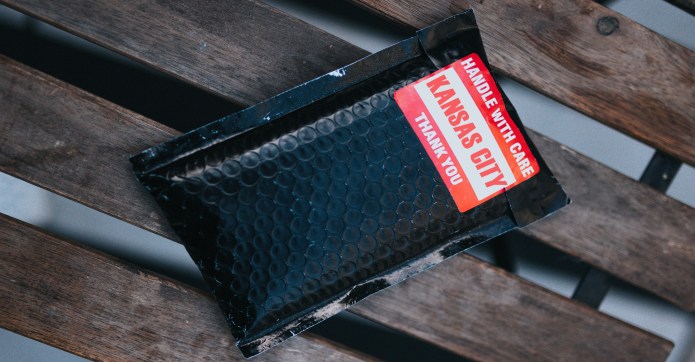
The Rockies were even more majestic than I had imagined. The Kansas Prairie, as stark as I’d expected but I hadn’t made room in my brain for the smell of cow patties for miles. The storms of Utah scared me so profoundly I knew I’d never make this trip back by car, ever again.

Of course, the first stop was Vegas, where I’d been a thousand times, and the 118 degree temps that did something weird to my car engine didn’t surprise me in the least. Thankfully, it was temporary, as I continued east and gradually north, making this move I never remotely had in my plans for my life.

I’d managed to amass 60 years on this planet without ever living anywhere other than Los Angeles, and now I was moving to Kansas City, Missouri, the heartland, the prairie, the home of tornadoes and Charlie Parker, a red state but a blue town, artful and socially progressive, even though it was here that I was called the N word for the first time ever … at least that I’ve known about. Seriously, I may just be the most sheltered Black person on the planet.

I am trying to find my identity in this new place that doesn’t require me to let go of what LA built in me, while wanting to flow with this KC charm and warmth. Trying to be both, trying to have both. In LA, I was regarded in my town’s music scene. Here, I’m barely a smudge on a wall, largely unnoticed, but not in a rude way, just the experience of a new birth and my own penchant for cocooning. I don’t even go out for auditions for the many plays that are being cast at the very theater where I work. My instinct, as I’ve said, is just to stay a little bit cocooned, and I’m not even certain why. The fight-or-flight pace of LA kind of did me in a little, so I guess I just want to breathe slower, talk slower, decide things slower, get involved slower, emerge slower. I guess. Just looking for simple.

Two years here now, and no I have not done the drive back west again (though I’ve flown home a few times now). I meant it when I said I had sworn off those torrential rains. I feel very settled here, and happy. Still not completely out of my performance shell yet, but that’s okay. I’ve done some singing. I chased fame and travel and record deals and pizzazz for so long in LA, and it beat me to a pulp, frankly. Just looking for simple. And yet even with the agenda to simplify, I still manage to over-commit myself. Total co-dependency thing. I definitely need more than just my once-a-week Al-Anon meeting. Winters blow here. I know, weird segue. I will never embrace the snow. It just isn’t in the bones of this Cali Girl. I know, I know, be open-minded.

I love the friends I’ve made in my new town. Few, which means fewer choices of who to call for a hang, or whose invitation to accept for a hang. I miss my LA friends like nobody’s business (thank God for Zoom!). That circle was and is VAST, and I am so much luckier and more blessed than I ever truly appreciated when I was actually there. But here, I sort of like it that my circle is small. Fewer decisions to make. Have I said yet that I’m looking for simple?

Here, I can embrace being 62. There, it’s the thing you’re supposed to hide. Artistic pursuits are blowing up for me here. In LA, I did the gig beat for nearly 40 years, and it was every experience from dazzling to grueling. No regrets at all. It was an extraordinary time in my life, but there wasn’t really any other avenue of my pursuits that ever went anywhere for me. Here, I’ve had firsts. Of course, everything I did in LA began as firsts, it being where I began life. But the firsts that have happened since I’ve been here are kind of dizzying. Amazing, humble, grand, small, precious firsts. My first-ever poetry reading where I was invited to be the featured poet (and I’ve had a few now) in a town known for its vibrant and weighty poetry community. First time having a hand in getting a jazz series started (at the theater where I work). First time I’ve gotten to be a participant in a wall mural (up at the iconic Unity Village). First time making a little documentary short about a Kansas City community event (the citywide Black Lives Matter street murals), and having it be my first ever Official Selection in a film festival. My first time ever having art of mine juried into a gallery exhibit, which is opening in a few days. My alcohol inks ‘bout to make their li’l splash! Pun intended! (If you know the medium, you’ll know it’s a lot of splashes of ink…never mind…)

I know that my children’s videobook winning multiple film festival awards (whaaaat???) has nothing to do with Kansas City, nor an alcohol ink of mine making the cover of a literary journal, nor having an entire concert of music (by the LA Metropolitan Master Chorale) created and performed around several of my short stories (all firsts), but I’m giving KC the credit anyway, because all these things happened while living here, and somehow here, more than in LA, I’ve managed to cultivate better focus in order to carve the space for these blessings to be made possible. Too much the blitzkrieg of Los Angeles, I guess, and all that that allegorically means, and which kept me just running, bouncing, collapsing, recovering, then running and bouncing again. Ad nauseam.

I’m exhausted. Still, two years later. Walking along the Missouri River humming “Shenandoah,” and the hiking trail that gives me genuine serenity, and strolling the halls of the Nelson-Atkins Museum of Art weekly — are all great balms that are slowly recovering me.

Did I mention I moved here 2 months into global lock down? Talk about throwing my own roadblocks in my way. I trip and fall a lot. Like…physically. I’m a klutz. But I’m starting to think that has whole other metaphorical layers of meaning for me and my life. And yet I persevere like a cockroach.

I like Kansas City. I might actually love it. No, yes, I definitely love it. I love Kansas City. I am mesmerized by how much art and theatre and music is embraced here. And then there are the city fountains (more than in Rome!), and the recent citywide installation of giant heart sculptures, 154 of them, all painted by different local artists, and which demanded my obsessed attention for 3 months, finding and photographing as many as I could. And the West Bottoms, and the River Market. And the 18th & Vine Jazz District, and the First Fridays Art Walks. And the stupefying amount of live theatre I’ve loved seeing, and not just at the one where I work. And my favorite building on the entire planet, the downtown KC Public Library, whose design is that of a GIANT bookshelf of classics. Crazy cool!

And even if none of that was going on, this move also means I now will not die having never left home. That’s huge for me. A dream I’ve had forever, though in my imaginings it was more along the lines of somewhere in Europe. But that’s okay, since KC is actually known as the “Paris of the Plains.” 🙂 No kidding.

I wouldn’t have chosen it on my own, but Kansas City came my way, and I happily said yes. Leapt. In a way I am not prone to do. I’m still saying yes. No looking back. Well, maybe some looking back. After all, I would take California earthquakes any day over the “Severe Thunder Storm” alerts that routinely pop up on my phone, and do indeed freaking deliver!

The Richest Girl in the World

This post originated on Christmas Morning 2020, after I had just finished pressing the button on the Christmas launch of my most unusual creative offering, THE RICHEST GIRL IN THE WORLD! What I offered then was that I knew that so many of us were more than ready to leave that strangest of years behind us, and have hope for a better, cleansed, redeemed, renewed world. I know I did. For myself, and my part, I had decided to usher in the new year with a children’s book I had written, because I believe it holds within it lessons that ring in this time of upheaval.

Today I’m updating this post, because I’ve remastered the movie, and hope you’ll check it out. I also believe that it STILL holds within it lessons that ring.

It’s a book that never existed in print, but instead has taken on the medium of a videobook. Inspired, in part, by the children’s classic, Peter and the Wolf, I simply couldn’t envision this story without it being told aloud, in the beloved tradition of the bedtime stories from our own childhoods. It was first conceived and written nearly 40 years ago, and over the decades has finally become what it was meant to be. Featuring over a hundred colorful illustrations, I had a blast narrating this tale on the indwelling nature of friendship.

When a sage old man shows up in an enchanting village, he changes the life of a little girl forever, who changes his right back. Underscored with a whimsical music score by composer Chris Hardin, THE RICHEST GIRL IN THE WORLD sets the stage for a timeless and quintessentially fable-istic tale. Lessons of empathy, gratitude, and seeing beauty everywhere are taught by the story’s two characters. In this new age where turning inward, self-examining, and soul-tending are no longer fringe flower-child ideas, but are in our everyday lexicon, and Namaste is a word everyone now knows, THE RICHEST GIRL IN THE WORLD is right on time to offer Kid Lit for a risen consciousness. 

And this newly mastered version has arrived to YouTube, JUST FOR YOU, because why not keep saturating the world with messages of love, peace, and gratitude? Why not, indeed!

For kids ages 8 to 108!

And Read On About this 40-Year Journey

I wrote this children’s book nearly 40 years ago. My first, my only. It’s been tweaked and polished here and there over the years, and each time has been put back in the drawer (or on the computer, as the years went by). It’s even gone through a few titles. Then maybe 25 years ago I started, in earnest, looking for an artist to do the illustrations. An artist friend of mine, the astonishing René Norman, who would have made magic with her own hands doing this, gave me some beautiful direction, and encouraged me that I could do this myself, even though I have never been that kind of artist. But with her encouragement I spent the next few years drawing then painting each canvas. It was painstaking (and sometimes painful) and time-consuming, but I got it done. And yet, even the canvases just got stored away, never to be used, as I moved on to other creative projects that seemed more pressing.

So, more years passed, and the world of independent publishing came into vogue, and because I was always intimidated by the children’s book world and therefore never dared try to get a publishing deal for it, the idea of putting it out myself appealed to me. STILL, I now have seven books in print, and this children’s book is not one of them. Maybe it’s children themselves I’ve been intimidated by. In any case, who knows why the story felt safer at home with me, but it did.

Then just a couple of years ago, after making a handful of little mini-documentaries and some other fun, arty videos, and beginning to get a handle on video editing, I thought, instead of a book, it could make a very cool multi-media, spoken word thing. Think “Peter and the Wolf.” I sure did! It was my absolute favorite storytelling experience as a child. So I started looking at my story again and lining it up with the artwork, which had been collecting dust, and realized I actually still needed several more illustrations, which I hadn’t thought about, as I had added to the story over the years. By this time, I’d started doing digital graphic design, so I was able to add to the collection without needing any supplies except my software. So now the artwork is a hybrid of digital and organic, and I think this has made it even more interesting.

Then last year, with the help of my dear friend Craig Pilo, and his state-of-the-art recording studio, I set about the task of recording the narration. We had so much creative fun making this narration work with one narrator (me) yet several voices needed. Truly gifted, Craig is. We still needed one more session to get it polished, and then Covid hit. I mean, it might as well have been the next thing to stop this project in its tracks, since I guess I was determined to spend my entire life making this thing a reality. The good news is, in the span of 40 years, I think it’s a story that still holds up. But yes, I had to go with the narration as it was, which was already pretty cool.

I then set about creating the moviette, tweaking, and tweaking, and tweaking, like the obsessive/compulsive animal I am, over these past few months, until all the puzzle pieces were assembled into some sort of coherent narrative.

The final touch, of course, was the music. Of course I wanted this story underscored. There is nothing that is a better emotional conduit than music. Dare I try to compose said music myself? I’m certainly no Prokofiev! And I’m always wary of “one-man-band” productions, anyway, yet here I was thinking about trying to do that very thing. Enter composer, pianist, and dear friend Chris Hardin, as there are most definitely better people for this task than I. I didn’t commission him to write a score for this; I asked him if he had any existing recordings of original music that he wouldn’t mind allowing me to use. He pointed me to his album “Reflections,” which had only come out a couple of years before, and said, “have at it, girlfriend!” Well….I don’t truly know how best to impress upon you just how made-for-each-other these beautiful piano pieces and my little story were. It took several weeks to painstakingly cull through every piece (12 tracks in total) to find just the right chunk, from just the right piece, for just the right scene, to emotionally enhance a moment. But when all was said and done, you would think this music was composed specifically for my moviette. Chris Hardin, as a talent, and as a friend, is a revelation.

And that was the final piece of the puzzle. So, you may be thinking, what on earth finally made me leap to the finish line, after 40 years vacillating? Cosmically, my own tendency is to look at this problematic and enigmatic year as the year I was always intended to share this message. Who knows if it all really works that way. What I do know for sure is that if living in a pandemic, with the burden of a stunning global death toll by this horrific virus, an alarming reemergence of racial strife in this country, and a collective global trauma that the whole world is experiencing has taught me anything, it’s … don’t wait. Make it happen. Whatever IT is. Don’t second-guess if it’s good enough. Put it out there. It is valuable. I recently stumbled upon a Facebook post by someone I don’t personally know, and I wish I could remember whom to credit for this, but I only (and do I ever!) remember the sentiment: By envisioning the things we create as love letters, vow to keep creating, praying, and affirming those love letters into the world, knowing that in the energetic world, out beyond conventional ideas of time and space, fame or money, they are received and enjoyed, and they fulfill their mission.

So, that’s what I’ve done.

CREATING THE CHARACTERS

There are only two characters in this story (though there are lots of “extras” helping to create the very special paradise this takes place in). These two characters have lived with me a good 40 years now. And honestly, they’ve just gotten better with age. As with folktales and fables, I wanted to give them more of an archetypal existence, thus they are known simply as the Young Girl and the Old Man, instead of having contemporary Christian names.

The Young Girl actually began as a young boy, and was that way for years until I realized two things: I didn’t want this to be an all-male story, where a little girl couldn’t readily identify with any character. And also, I realized she was me. A child who marched to her own drummer, and didn’t fit in most social circles. These are often the struggles of childhood, with our attempts to assert a voice and an identity in our very own way. I was such a tomboy as a kid, and that seemed a natural for this character, so since she originated as a boy, there wasn’t a whole lot, visually, that needed to be changed. The more I could infuse the character with dynamics from my own often awkward, yet crazy curious, childhood, the more real she became.

Likewise, the Old Man is quintessentially fable-istic. The wise old seer, the elder, the one who has wisdom to impart, and an almost monastic centeredness that always draws others near. And like all lore, twists on that theme do happen, as the teacher also becomes the student. The Old Man was an instant and easy inspiration. He is an amalgam of my two fathers, at once artistic and creative, living with flights of fancy, as was my bio-dad, and grounded in sagacity and homey charm, which was quintessentially my stepdad. He is my grandfathers. He is the many teachers, mentors, ancestors, both male and female, whom I’ve learned from throughout my very blessed life. And his look and dress was very specifically inspired by an elderly bohemian I once met named Rozzell (introduced to me by the very artist friend, René Norman, of whom I spoke earlier). Rozzell had made an indelible imprint on me. And he seemed never to be without his red kerchief around his neck.

With these two characters, I have represented old/young, male/female (even the gender fluidity that is beautifully becoming a part of our present-day consciousness), and a world of color, both in the visual-hued sense of the word AND regarding ethnic and racial diversity. And none of this is anything that will likely dawn on a child watching this moviette, but is simply the very rich world we do live in. So, it was important to me that I create a story where inclusion was simply a given and a power.

Beyond that, these two characters have helped me to create a world where endless are the possibilities, and where the virtues of gratitude, compassion, and being present are paramount to existence. It’s an idyllic world, and at the same time there is a worldliness and a timelessness to it.

I think young children will be drawn to these two characters. They’re playful, but at the same time they’re thoughtful. They teach lessons about empathy, and seeing beauty everywhere. And here’s the rub; I think adults will be drawn in by these two as well. As, here we are, in an age—one might call it a New Age—where turning inward, self-examining, and soul-tending are no longer fringe, flower child ideas, but are in everyone’s everyday lexicon. “Namaste” is a word that now lives beyond the ashram and the yoga studio. And here stands a story, delivered by these two characters, that is all about risen consciousness, and perhaps a shifting of our ideas about what’s important in life…..told in a simple tale of friendship.

I have loved these two characters for a long time. And they finally became ready to tell this little tale for me. THE RICHEST GIRL IN THE WORLD. For kids ages 8 to 108, I like to say. Now available to watch absolutely free on YouTube. Because … let’s just spread love.

Spiritual Algorithm: A Prescription for This Age of Pandemic

rockypeakblog

Navigating the murky waters of life is a job with tenure.  All the money and station in the world won’t reprieve us from the task.  Below are 9 simple practices that can mean the difference between the grind of life (or even the blunt interruption of that grind) and truly living.  Costs nothing.  Big Pharma has no equity in THIS medicine.


  1. Turn away from the anxiety-fueling news programs that litter television and the Internet.

Just refuse them.   They are designed for one agenda only —— to whip us into a distracted frenzy, and by virtue weaken us and our pocketbooks at the seams, because having an entire culture in panic mode is profitable, and is never about being in the public’s interest.  Find your news through more legitimate sources.  Do the homework needed to figure out who and what those are.  Information is valuable and crucial; hysteria never is.


  1. Read for pleasure.

As a writer I want to encourage books. I want to encourage good books.  I want to encourage literature.  But hey, read a magazine, just read —— for pure enjoyment and expansion.  And try as often as possible to do it outside the digital and electronic universe.  Kindle and iBooks are both fun and convenient, but don’t let them be your exclusive source for reading.  The brain needs a good chunk of quality time every day to be removed from electromagnetic energy and social media, and to be reminded of the world of imagination and connection that does exist beyond our digital screens.


  1. Meditate.  OR . . .

…at the very least find a way to simply be in silence and stillness for a few minutes every day.  The more minutes a day you can find in that quiet, the better able you will be to heed the inner voice, and the better everything will be.  Guaranteed!   Consider a wonderful memoir by Sara Maitland on her experiment of withdrawing from the world in pursuit of silence.  There is a whole world of discussion to be had on the topic and its impact on a society, and which is utterly fascinating.  For now, for this, simply allow yourself a few minutes each day to power everything down.   And listen.


  1. Connect with Higher Power.

This term has as wide a berth as the ocean, so even the most ardent atheist can find his or hers.  Something that is greater than your pedestrian self and has something to teach you, offer you, feed you. Maybe it’s the Collective Unconscious. Maybe it’s your own higher consciousness, which exists in every human, usually buried beneath all the traumas and dysfunctions, but there, just ripe and ready to guide us, if we’re keen to do some unearthing.  Maybe it’s nature.  Maybe it’s the source within.  Or a source out there. Maybe it’s simply goodness.  It will show up differently for every individual on the planet yet is that unquantifiable something that maneuvers us around the land mines and connects us to each other.  There is no need to affix a label; simply be with it.  Find yours, and plug in regularly.


  1. Create, even if you’re not an artist.

“Artist” is merely a label.  We all have creativity and imagination within us, and it can show up in the most unexpected cloak, which is usually how it works anyway.  Feed it. Allow it to feed you.  Have fun with it.  The benefits to soul are untold.  In this time of quarantine, and out.


  1. Be a child again (closely linked to the above, and which is not the same as being child-ISH).

There has been so much obligation, commitment, management, planning, and fortune-making that has governed our adult lives that we can easily allow it to collapse our spirits.  Easy to get so caught up in building the life of our dreams that we forget to actually live the life of our dreams.  These mandated lockdowns and Stay at Home orders have forced us to slow down, whether we’ve wanted to or not.  As a result, some truly profound epiphanies have been had from the many about the lives they’d been living before this pandemic.  So, every once in a while let it all go, and do what children do. Precisely because we are presently in the state of severance, throw Zoom parties. Live-stream living room performances for friends.  Stage social distancing drive-by parades. Play dress-up to come to the dinner table.  The ideas are endless.  The point, to play fiercely and with release and abandon.

The flipside of that same spirit … do nothing.  The Italians have a delicious term for it —— dolce far niente —— literally translated as the “sweetness of doing nothing.” They have raised it to an art, but in our ambition-worship culture we have stamped the label of shame onto it.  We do not need to be in the constant state of planning, producing, and consuming.  Precisely because of this pandemic, we are in trauma.  We are in grief.  You are okay to not be okay.  So, take the pressure off.  Smile at nothing.  Sit and gaze.  Daydream.  Decompress.  It is the crucial yin to our Everest-conquering yang.


  1. Be in nature.

Communing with creatures beyond our pets and other humans, moving among the wise old trees, strolling along a shore, recognizing the cruciality of taking care of the earth, this is what it means to be in nature.  For the time being, but not forever, our access to beaches and nature trails has been limited by the necessity for flattening the curve of this virus.  Even so, it is possible to snag ourselves a little bit of nature every day.  Put on your protective mask, walk outside your door, and you are in it.  Even in the city.  Just walk, and marvel at the sky (cleaner these days than ever before with fewer cars on the roads).  Equal parts meditation and exercise, being in the nature right outside our door can open the heart chakra and shift our receptor paradigm to receiving or, perhaps and more pointedly, feeling worthy of blessings.  It increases our ability to see that blessings are flying all around us like gnats.  And it’s not only the stuff that feels like blessings.  It’s even the stuff (or people) we consider the opposite, because every encounter serves as a teacher —— and may actually be where the real gold lies. Wait, what? All this from observing flowers and trees?  Oh, yes.  Until our beautiful beaches and glorious canyon trails can safely reopen, even the smallest patch of garden or that duck pond in the neighborhood can be that salve and conduit.  Nature is quite remarkable at showing up anywhere and opening the vessel within for our daily access.


  1. Create a daily gratitude ritual . . .

…particularly during this coronaspell of death, sickness, fear, and the loss of “normal,” when it’s harder to see blessings.  It can be a prayer, a journal log, a mantra, a meditation.  Even in the various periods of my life of not feeling especially grateful, I, for example, always found such beauty in the tradition of blessing one’s food.  What a lovely idea to express out loud our thankfulness for the bounty on our plates, and for not taking a meal for granted but cherishing it for what it gives us, especially considering how many don’t have this luxury. Now, imagine employing that gratitude practice with everything.  Just imagine.


And finally . . .


  1. Be of service.

From sewing and dispensing face masks, to surprise drop-offs of groceries at someone’s door, to making food for the homeless, to outreach calls, this Age of Pandemic has shown what people are made of, and that it isn’t only the front-liners who are able to be of service to the community.  We all have the ability to be there for others, whether an individual or our community at large.  Service is the most restorative unguent there is for self-absorption or for trying to find meaning in a world that often seems senseless and cruel, especially in these strange days.  Maybe you aren’t struggling with that.  Many are.  Pandemic or no, this might just be the single most potent go-to for establishing or recovering ourselves as persons of value on the planet…

and within.


Angela Carole Brown is the author of Bones, Aleatory on the Radio, Viscera, The Assassination of Gabriel Champion, The Kidney Journals: Memoirs of a Desperate Lifesaver, and the 2018 North Street Book Prize-winner for Literary Fiction, Trading Fours. She has also produced several albums of music and meditation.  Follow her on Twitter, Facebook, Instagram, YouTube, Goodreads, Amazon Author, & Bandcamp.


A Rose Knows

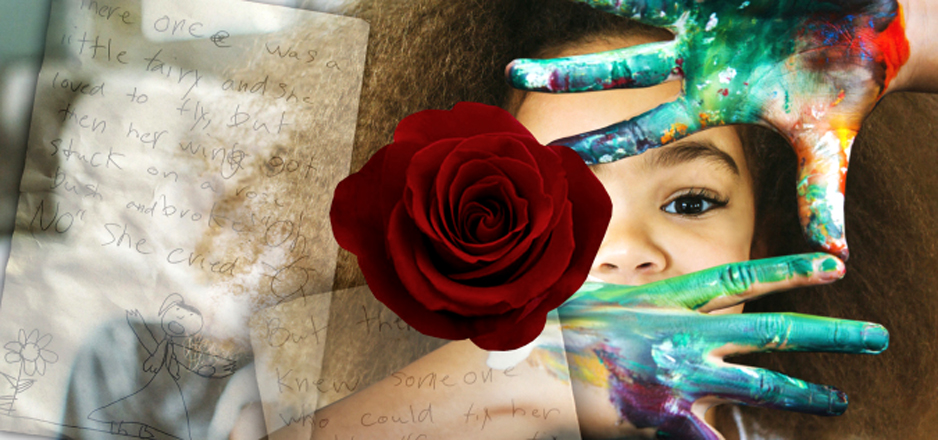
Portrait of cute gril with big afro

 A rose blooms and releases fragrance.
It doesn’t question its deservedness.
A rose just knows. 

I’ve been wanting to tell of this encounter ever since it happened a few months ago, but have waited without really knowing why. Until yesterday morning, when I realized I’d been waiting for the title of my story. Victoria Thomas of the Agape Center, who was the visiting speaker at the spiritual center where I chose to spend Mother’s Day morning, at one point during her talk said the above quote. As soon as I heard this, I knew my piece was ready.

This spiritual center that I have newly started calling home, and sometimes sing at, hosted a craft faire this past Christmas, and anyone who had a craft was offered the opportunity to have a booth. I’d hesitated a commitment, and lost the opportunity, as booth space was spare and quickly snatched up. I didn’t represent a single thing that day, even though I have CDs, books, I’ve been handcrafting dreamcatchers for the past year, I make dolls. I sort of felt frustrated with myself that I’d had the instinct to hesitate, but ultimately it was okay as I had great fun attending in order to support all the other artists, crafters, and friends. And to top that off, on the day of the faire, right outside the front door of the center, the neighborhood’s Christmas parade was going on, so it was just one of those magical, wonderful days to be alive and to be part of a community.

“Would you like to buy a copy of my book?” she asked.  She was eight years old.

The bazaar was teeming with booths and tables of handmade jewelry, and crafted dreamcatchers (damn it, I make dreamcatchers!), and exotic crystals, and one-on-one healing sessions of every kind, from Reiki treatments to spirit animal readings. I’ve always been a sucker for a craft faire, especially if the general bent is New Age-y. I am crystal and sage mama. Always have been, and this was like a miniature version of the Whole Life Expo.

I’d already pocketed a few choice purchases. Knickknacks that would add to the energy and color and boho spirit of the 700-square-foot home I call my Zen cottage. I’d just made the silent promise to myself, “No more. You’ve shopped plenty now.” But who says “no thank you” to a little girl?  And a book?  She didn’t have a booth, I saw no inventory; she’d just planted herself in a corner.  I needed to see where this would lead.

“You have a book?” I asked her.

“Yes, I’m a writer!” she offered proudly.

“Well, okay then. How can I possibly say no to that?  How much for one of your books?”

“That’ll be one dollar.”

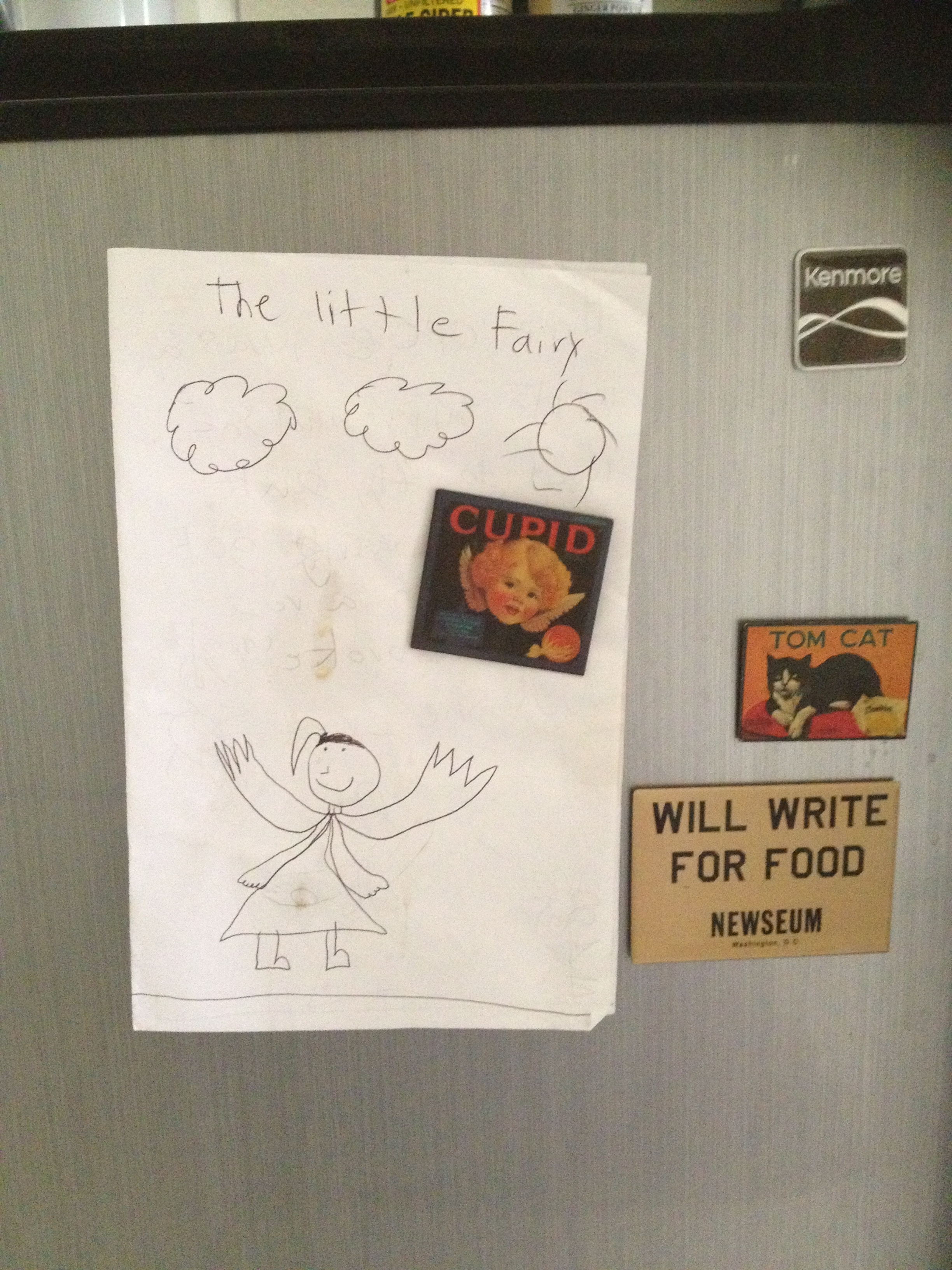
As I handed her a dollar bill, she proceeded to pull from her knapsack a single piece of notebook paper, folded in half.  I could barely contain a giggle. The title on the “cover” was The Little Fairy, and was adorned with the drawing of a stick figure sprite, some clouds and a sun.  I smiled so wide at my purchase, making sure to show her my delight, and couldn’t decide if it was more precious or ballsy.

I opened the folded piece of paper to reveal the story inside:

There once was a little fairy and she loved to fly.
But her wing got stuck on a rose bush and broke.
“Oh no” she cried.
She was sad so she went home and tried to fix it but she couldn’t.
But then she knew someone who could fix her problem.
“Can you fix my wing?”
“Sure.”
The End.

Whaddaya know, a lesson in conflict resolution. Made as simple as it truly is, if we adults could only manage to find our way around the viscous clouds that apparently go with adulthood.

“What a wonderful story,” I said to her. “I hope lots of people buy your book today.”

“Thank you!” she blushed.

I couldn’t rid my brain of this little girl for the rest of the day. Was it her creativity that I found so irresistible?  Or her unbelievable tenacity to assimilate with the adult world around her of product and consumerism? For certain it was her purity of spirit, and the compulsion to put her unfiltered, uncomplicated, I-don’t-need-no-stinking-booth carpe diem spirit, and her entitled (I write, therefore I am a writer!) energy into the ether.

“What’s your name?” I asked her, before I walked away.

“Angie,” she answered.

“No kidding.  My name is Angie too.  Except that everyone calls me Angela now that I’m an adult.  But look here, we have the same name.”

All Angie could do was giggle.

“May I share something else with you?  Not only do we have the same name, but I’m a writer too.”

“Where’s your book?” she challenged, without even a moment’s pause.

“Well…I….I…..”    I didn’t have a ready answer.

She just smiled, and let my “well…” hang in the awkward air, waiting for a conclusion that never came. I smiled back, wished her the world, and kept on roaming, but with my tail somewhat between my legs.

IMG_4566

I had absolutely fallen in love with this little girl’s mighty chutzpah, and decided that her book would have an honored place hanging on my refrigerator door behind a magnet, reminding me always. Reminding me always.

I see grace in everything. I just don’t see the wisdom in not. Because it is a paradigm that functions to create an environment where I always feel taken care of.  And on that day, with that encounter, grace was in full action as I was taken care of by a young girl who taught me, in no uncertain terms, that I needn’t ever question my deservedness.  A rose certainly doesn’t.

Neither did Little Angie.


References:
Victoria Thomas of Agape Center
Center for Spiritual Living Granada Hills


Angela Carole Brown is the author of three published books, The Assassination of Gabriel Champion, The Kidney Journals: Memoirs of a Desperate Lifesaver, and Trading Fours, is a recipient of the Heritage/Soulword Magazine Award in poetry, and has produced several albums of music and a yoga/mindfulness CD.   Bindi Girl Chronicles is her writing blog. Follow her on Twitter, Facebook, Instagram & YouTube.


The Little Death  (Un Poéme Concret)

The Little Death (Un Poeme Concret)


Van Gogh’s Ear

Abstract Banner

he stared at his blank canvas for hours.

frustrated.

couldn’t get a thing done.

finally he just doused his naked body with flat green house paint

and in a magic-mushroomed fog

threw himself against the elevator lift.

he picked himself up off the floor.

stepped back.  stared.  hmmm.

it was this perfectly contoured jade silhouette of his body

divided in sublime harmony and symmetry

right between two testicles by the parting of the

double steel doors.

from that day forth every time he yanked on the ropes and opened that thing to leave

he’d flash on the excruciating image of his

right nut soaring one way and his

left nut soaring the other.

was there a symbolic message somewhere in that image, he wondered?

that maybe castration was the true doorway to freedom?

as many women as there were who had messed with his head and therefore his art

he had to at least consider the possibility.

he got the hell outta there for the night and went to a neighborhood bar.

walked in and saw the most beautiful woman he’d ever seen.

kinda like an angel.

reminded him o’ that old joke :


man walks into a bar.  sees the beautiful woman.

tells her he wants to make sweet love to her.

Sorry i can’t, she quips, i’m on my blue period!


he downed a couple of quick shots of Old Forester.

slapped his money on the bar like a cowboy.

decided against approaching his beautiful woman.

and sulked on back home.

thought to himself :


why’d that damned Vincent have to go and cut his ear off,

and raise the bar of brilliant suffering for all the rest of us?


Angela Carole Brown is the author of three published books, The Assassination of Gabriel Champion, The Kidney Journals: Memoirs of a Desperate Lifesaver, and Trading Fours, and has produced several albums of music and a yoga/mindfulness CD.   Bindi Girl Chronicles is her writing blog.   Follow her on Twitter, Facebook, Instagram & YouTube.

Four Points of a Twenty-three Day Odyssey


Abstract-Painting-Fluid-Acrylic


1.

. . . And he told them he didn’t do portraits.

They asked him why, and he said because

the last time he did a portrait he was

screamed at by the model who claimed

he didn’t capture the true her.

As if she might’ve had some clue

as to what that was.  See, when the work

gets too personal for anyone else besides him,

that’s when he always gets into trouble.

And there are all the little ulteriors that

hang in the balance, besides.

So he doesn’t do them.

But this family wouldn’t leave him alone.

And it’s not as if he doesn’t like to be begged.

Who doesn’t?

But these people were REALLY trying to

twist at his heartstrings.

They said the portrait was in memory of their dead mother.

Oh, boo hoo.

And when that didn’t work – sentimentality rarely does with him –

then they tried to yank on his empty pockets

with offers of ungodly amounts of money.

And that is where he fell.

It’s where he always falls.

Plus, they were able to convince him,

gullible fool that he can be,

that a dead woman could hardly

scream at him about a job not well done.

So they all shook hands, and the process began.

An impossible one, he would later come to find,

but then he’s always been of the opinion that

Creation is a job for someone with at least

a high school diploma or the equivalency.

And at all times requires a crash helmet.


2.

. . . How had he let himself fall for it again?

How do you paint someone you don’t know?

Because, you see, it isn’t just a face you paint.  It’s a spirit.

An energy.

So, faced with that puzzle, and since he didn’t know the dead woman personally,

he decided he would do everything he could think of to learn about her life.

He started gathering, collecting, rallying around him all the trinkets that spelled her life.

Anything her family could possibly dig up.

Photographs.  Letters.  A handkerchief bearing the scent of

lilacs and mothballs.  Very telling, that one.

Purses with lipsticks glued inside.

There was a pair of old nylons,

never worn, just packed neatly away in a rusted hope chest.

A brooch of black pearls and emeralds.

Most of the emeralds missing.

A very badly tarnished silver teething cup

with a name inscribed.  Hmmmm.  Laura.

Just like the movie.

A dead rose from Laura’s funeral, which someone had

flattened between the pages of

Psalms and Proverbs.

And an old, musty, floral-printed dress.

He placed every bauble and memory on tables and chairs all around him,

And just sat for days,

staring at the stained wallpaper,

feeling a bit like the irascible Raskolnikov.

He held in his hand the dead woman’s hair brush,

all ensconced in tangled and mangled

grey and black hairs.

Slowly he lifted it to his nose to smell.

Only hair.  Nothing special.

You know, what can you really get from hair?

Maybe a hint of old, stale Bergamot.

Just trying to get acquainted.

He felt like he was on a first date.

What the hell.  He popped a few Black Mollies and started.

But to his hallucinogenic dismay, his first stroke was weak –

ignorant – uncommitted – bullshit!

The color was wrong, the light was wrong, the intent was wrong.

So he threw it out, and sat three more days.

He had run through every canvas and every little tube of his oils

trying to express dead Laura.  Then he couldn’t even afford to

re-stock his supplies!

So in pure and pissed-off desperation, he thought to his huffing self,

I will slit my wrists if I have to,

and paint her on the walls with my own blood!

The truth is, it’s just too goddamned expensive to be a starving artist these days.

And a good dental plan certainly couldn’t hurt to make it a more sought-after position.


3.

. . . So he just sat.

For days upon days with the sights and smells of dead Laura.

Reading her letters, memorizing her penmanship, sleeping with her quilt draped over his legs.

He paced his flat for countless unbathed, sweaty days,

and went through several fifths and an easy carton of Marlboros.

He listened to the weeping timbre of Callas on an old turntable, because that voice was how he felt.

Until one day, out of the blue, after all of the madness,

for mad was what he had become,

he suddenly realized – he was wearing her.

Laura.

As one puts on a cloak and lavishes in its feel, so he wore her very life on his ripe body.

It hung from his limbs, perhaps a little snug in the arms,

but every part of her was now in his grasp.  Every little nuance.

He knew her better than he knew himself.

He was a bit awed and trembling, but needed to shake it off so that he could keep going

and actually get some paint to canvas.

He immediately hastened to the business of stretching a canvas on a 10 ft. x 10 ft. frame.

So huge and unmanageable was the thing that he had to literally lie on top of it.

He mixed paints with such a flurry that he stumbled clops of swirly color onto the canvas

before it had even been given the chance to be completely mixed,

so much faster did his head work than his hands.

He painted her with a fever by day, and with a pitch by night.

Hues of every conceivable shading and variation surfaced.

Thoughts toppled over one another to get to the canvas.

And a sort of unhinged randomness became his M.O.

For twenty-three haunted days of glorious, glorious madness

he pranced and flung paint to the round-the-clock screams of Fishbone

(he had long, by this point, abandoned Callas)

and a half pint of Old Forester.

And it was – a masterpiece.

Was he even allowed to feel that?

Somehow, he didn’t care.

He circled it for fear that he’d dreamt it.   But it was real.

And he breathed in the smell of her, which was beyond the pungent turpentine, stale bourbon, and cigarette smoke.

He stared at her until she bewitched him, and he would be so bewitched.

She was strong, yet sad and eloquent, just like her love letters.

And angry too, like that cracked hand-mirror that he could just see her

dashing against a wall.

Yet vulnerable, as in the melancholy eyes that graced every one of her photographs.

But most of all . . .

Well, look for yourself.

Is she not the most exquisite beauty you have ever seen?

It probably comes as no surprise by now that he had

fallen in love with Laura.

The minor detail that she was dead didn’t seem to stop that

ball from dropping, did it?

So the cliché IS true.  All artists do fall in love with their models.

Even the expired ones.

This career is definitely not for the faint of heart.


4.

. . . And then as if the laws of fate weren’t already

finding him the perfect punch line to a joke,

the family of dead Laura was not, as it turns out,

especially thrilled with his portrait after all.

Idiot!   (This was to him, not them)

He should know better.

How many times in the past had he already walked into this trap?

See, they wanted something they could put on their mantle like a holy shrine,

to decorate with flowers.

They weren’t interested in something they might have to ponder!

They wanted something they could readily identify.

Like a police sketch!

“It doesn’t even look like her.”

“It doesn’t look like her?  It is the very essence of her!”

They asked him how he would know that.

“How would I know that?  How would I know that?

HUMAN NATURE IS MY JOB!”

“Human nature? Human nature?  Is that what you call it?  Human nature?  Well, maybe buddy, but what do you know about our mother? What do you know about our mother? What do you know about our mother? Whatdoyouknowaboutourmother!!!”

They were mindless wind-up toys.

He could not stand the sound of their voices.

“We’ve lived with her all our lives.  What have you lived with?   A hair brush?  A broken mirror?”

He finally burst:   ” I’VE WORN THE PANTYHOSE!  CAN YOU SAY THE SAME!!!?”

What kind of fetishistic weirdo are we dealing with?  they must surely have been thinking.

He didn’t care.

The truth is, they’d’ve fared better taking her photo to a booth on Coney Island for a three-minute chalk portrait,

and he told them as much.

They called him a narcissistic dilettante.

He called them cretins.

And once again, between artist and the

rest of the conscious world, it seemed,

there lay the abyss.

And so the family of dead Laura stormed off

with all her trinkets and whatnots,

and he walked away with no money in his pockets,

but his own Laura right there on his wall,

where no one could ever touch her again.

She was his.  He was hers.

And as he sipped, not swigged this time, his shot of Old Forester,

he could not help but reflect on an Ingmar Bergman line:

I could always live in my art, but never in my life.


Angela Carole Brown is the author of three published books, The Assassination of Gabriel Champion, The Kidney Journals: Memoirs of a Desperate Lifesaver, and Trading Fours, and has produced several albums of music and a yoga/mindfulness CD.   Bindi Girl Chronicles is her writing blog.   Follow her on Twitter, Facebook, Instagram & YouTube.