OLD

New_Beginnings

“If wrinkles must be written upon our brows, let them not be written upon the heart.”
– James A. Garfield

“May you live all the days of your life.”
– Jonathan Swift

My New Year’s Resolution this year:  TO BOLDLY GO WHERE NO ONE HAS GONE BEFORE.   Wish me luck!    And should I happen to get lost in the Black Hole, somebody please feed my cat.

Symbols have always been important to me.  They are only imbued with whatever power we give them, but when they are imbued they resonate loudly, penetrate profoundly, and have the absolute ability to shift paradigms.  I’m also a perpetual seeker, so I always seem to be in search of life’s answers to the questions that matter; our place and role in the world, our alliances and community with other living creatures and the reasons for them, etc.  So, needless to say, tongue-in-cheek resolutions aside, the transition of the New Year has always had powerful meaning for me.  Forever, I have practiced certain rituals, usually inward-turning ones, that help me to reflect, restore, reform, renew, and remember.  Reflect on the choices I’ve made in the year that is leaving, and whether those choices have reaped what they intended.  Restore balance where things have begun to feel out of control, and sanity where insanity has been allowed to rule.  Reform habits that have now grown so old and dusty that they no longer serve.  Renew, in order to make room for better habits and better mindsets.  And Remember Everything, toward maintaining or gaining humility, understanding, clarity, lessons.  Because if it’s not about always evolving toward our greatest, god-realized selves and away from our basest selves, whenever possible, and perpetually, then what IS it all for?

New Year’s Day just also happens to be my birthday, so truly this yearly symbol and practice and ritual could not be more perfect for me.  Parties, celebrations, candles, champagne, friends and gatherings aside, my birthday has always been, for me, an opportunity to turn inward, to claim some part of the day for solitude, self-inquiry, meditation/prayer, and perhaps even a symbolic deed.

Example:  One year (which had been an unusually difficult one) I took the midnight hour moment (after counting down and then singing Auld Lang Syne with the band, of course, because I’ve sung a gig on every New Year’s Eve  since 1988) to unfold a list that I had made of every difficult and painful moment that had occurred that year, and I proceeded to ritually tear it up in order to say, to myself, to God, to the Source, to the Collective Consciousness, however it actually works, that I was done with those burdens and embracing a new consciousness and a new energy.

Well, here I am on another birthday, and other than writing this thought I’ve no plans except to watch the Rose Parade on TV with my breakfast and mimosa, maybe take a walk, go get a massage, or do some living room yoga.  Perhaps I’ll end the day at the movies (one of my favorite pastimes).  Who knows?  As I’ve anticipated today, I’ve loved the idea of making no plans, because it is SO NOT me.  I’m a planner, an organizer, a connector of dots.  There’s something lovely (but a little scary for an anal-retentive planner like myself) in the idea of “let’s see where the day takes me.”

My friend Robin Swenson recently posted on Facebook, in response to all the birthday wishes he’d recently received (Capricorns forever!): “getting older never gets old.”   I absolutely cheered to read that, and reflected back to my 50th birthday.  Not only had I spoken “50!” out loud, which I realized was a great sin, according to many of my female friends (and especially being in the business I’m in?!) but just three days prior to that Big Day I dared to throw the biggest celebration I could possibly think of, which included an orchestra, a rock star, and a big-ass cake with a big-ass “50” written across it in chocolate-covered strawberries.  I know women who slink through their “big one” on tip-toe, hoping no one will notice.  I also realize it will be impossible not to sound self-righteous when I say that I didn’t want to be that woman.  To each her own, of course, but I just really didn’t want to own shame about turning fifty.   And the truth is, it’s a tough quest, but at the very least I figured I would fake it ‘til I make it.

And so, a party.  A big-ass, brazen party, which I will remember with a giggle for the rest of my days.

That said, it still wasn’t the simple pill that magically eradicated all my struggles with aging.  But it was a damned good start, and a damned good party.  And yes, because New Year’s Day is my birthday, those inward-turning reflections often (though not always) ring with themes of aging.

The above quotes came from two really great cards I received this year.  When you hit a certain age, the cards start reflecting either good-natured jokes about old age (usually welcomed) or more sensitive reflections on the beauty of aging (never a bad idea, in this fragile, age-obsessed culture).  These two have given me particular pause.

We all know at some point in our lives (if we aren’t already there) that we’re going to have to make peace with aging.  We are destined for this reflection.  At least if you’re from this American culture.  Other cultures embrace their elders as the venerated among them.  And that veneration being inherent in the very blood, there is no real need for reflection upon it, for it is welcomed as a crown.  But in this culture, we have had the great misfortune, shaped and molded by our media, of nullifying our elderly and the very idea of growing old.  We’d rather die young and leave a good-looking corpse than to wrinkle, lose hearing and bladder control, grow gray or bald, have to depend on our children for our care, and watch the sexual part of our identity slowly fade away.  These are mortifying concepts to most Americans.  And mortifying not because it means being closer to death, but because it means becoming society’s invisible.  How do you claim thick, opaque, rich, visibility in a society that refuses to regard you?

And therefore, at least if you’re a thoughtful and conscious human being, the time will come when you must reflect on aging, and make peace with it.

I have often referred to my “old age” with a self-deprecating humor, a way to deflect my sense of grief over losing my youth, and to disarm its power.  I am often told to stop that.  And while I understand the impulse in my loved ones to encourage me to love myself, and I merely say “thank you” in response, what I really want to do is tell them to wake up and smell the coping mechanism, and to please allow me that.

On the other hand, I have lately been observing the heartbreaking tendency in some women, who are hovering around this age, to be mortally unforgiving of their bodies’ age-related transformations, in ways that are not remotely meant to be funny or to share a laugh about.  This is not even grief.  This is downright hatred of self.  It is venomous and venal, the stuff of cautionary tales and selling one’s soul for that shiny piece of youth. I often feel surrounded, and I try desperately to counter the onslaught of self-repulsion I hear with that humor I try to use, to be the voice of irreverence, if not reason.  But more often than I’m comfortable with I find myself falling in line with the rhetoric, and the next thing you know I’m spitting my own disgust at my growing thighs in the choir of I-loathe-myself commiseration.  Like I said, a tough quest.  I feel for women’s restlessness, and I retreat to the comfort and safety of my jokes, and I tell myself that my making jokes about aging is different, very different, and that their restlessness does not belong to me (even if I do borrow it from time to time), that my humor is a positive thing, a way of embracing aging, of not having to desperately cling to youth, of refusing to view old as a dirty word.

If we say OLD enough times, it’ll lose its power.

But I suspect it’s all the same animal, and I am as guilty as anybody.

I have had a recent epiphany regarding this matter. (I love calling these little thoughts and discoveries epiphanies, because it automatically eliminates any contradictory position.  There is sacredness to one’s epiphany.  You don’t dare touch it.)  It is this:

I can either yearn to be young again, a place to which I can never return, therefore the instinct to obsess over it is a complete, self-sabotaging waste of energy; or I can embrace the age I am by simply choosing to be better at it.

One way I can accomplish this is to realize, and own, that my graying hairs, my creeping lethargy, my mid-section spread, my aches and pains that seemingly come from nowhere, do not belong to me; they belong to my body.  And my body is not me; merely the house I live in (I have my Buddhist and Eastern-thought studies to thank for that implantation).

And by being able to put that in its proper place, perhaps I stand the chance of forgiving myself these “afflictions,” as I have viewed them. Of recognizing my own power to be empathetic to them, and to ultimately transform them from afflictions into trophies.  Of reconciling both the flower AND the thorns of my body.  Of claiming the truth that aging isn’t a sentence – it is a call-to-arms.  A call for me to wake up and be alert, to realize that the days ahead are more precious than the ones behind, to recognize that the awareness of time running out gives me (a naturally lazy person) a swift kick in the rear and tells me to move, to produce, to achieve, to make my mark and leave my legacy, and to make every moment in the remainder of this life one of quality and vibrancy.  I’m in the most thankless business there IS (the entertainment industry) when it comes to the subject of aging.  And I’ve watched my comrades, who have been lighting up stages and electrifying audiences for years, suddenly start scrambling to figure out how to stay relevant in an industry that reveres extreme youth.  I have absolutely no answers to offer here.  Only my own gut telling ME to stop scrambling.  Stop panicking.  Stop trying to please people who barely see me.  Stop trying to fit my square peg in the round hole that is this business.  To, instead, make whatever it is I have to make, to create, to produce, to contribute to this world, on my own terms.  And if I’ve learned anything from my Eastern pursuits, I’ll learn to simply do the deed, and let go of the outcome.  All I can do is my part.  With integrity.   With clarity.  With the kind of self-love that makes me take better care of myself, yet with the compassion to forgive my body’s DARING to get old.

And it means not being afraid of that word … OLD … but instead shouting it proudly to the rafters.  Like, say, a birthday party with a rock star?  Because while the word may invoke our Western-culture-indoctrinated images of fatter, slower, frailer, grayer, less sexy, invisible … it also, and more importantly, means Wisdom.  Experience.  SeasoningAMAZING Grace.

That was 50’s epiphany.  Today I woke up with aching joints and cursed God for making me fifty-four.

“Old age is no place for sissies.”
– Bette Davis

Happy New Year, my friends!


Angela Carole Brown is the author of three published books, The Assassination of Gabriel Champion, The Kidney Journals: Memoirs of a Desperate Lifesaver, and Trading Fours, and has produced several albums of music and a yoga/mindfulness CD.   Bindi Girl Chronicles is her writing blog.   Follow her on Twitter, Facebook, Instagram & YouTube.

A Bindi Girl Christmas Story

… and the true meaning of Christmas  (with a little help from Rodgers & Hammerstein).


Angela Carole Brown is the author of three published books, The Assassination of Gabriel Champion, The Kidney Journals: Memoirs of a Desperate Lifesaver, and Trading Fours, and has produced several albums of music and a yoga/mindfulness CD.   Bindi Girl Chronicles is her writing blog.   Follow her on Twitter, Facebook, Instagram & YouTube.

AMAZING GRACE : Have We PC’d the Marrow Right Out of It?

amazing-grace

As we prepare our tables for Thanksgiving and our hearts to be in a space and place of gratitude, a song that always rings in my head is Amazing Grace.  I’ve never known a song to express such humility of spirit, and perhaps the association in my brain is because humility is the first step toward gratitude. Gratitude is about accepting one’s present, as opposed to resenting one’s past or coveting a certain future. It is about humbling oneself to being moved by the great fortune of being alive and being loved. I believe that gratitude cannot and does not exist when one’s legs and knees are stiffened in a kind of pride and entitlement. It takes humility first to experience an attitude of gratitude.

So, in preparing my own symbolic table this year, I decided to read up on my favorite hymn.  Amazing Grace has often been associated with the American South, and I, for one, did think its origins were from the tradition of the Negro Spiritual.  It was, in fact, written by an Englishman.

But here’s where my own mental association wasn’t completely off-base.  John Newton was an English slave trader, trafficking thousands of men, women, and children from Africa to the auction blocks. In 1748 a violent storm threatened to sink his ship. Frightened for his life, he made a promise to God that if he survived he would change his ways. And sure enough around the age of 45, he had a crisis of conscience and became a minister and a composer of hymns. Yet it would be years later before he would give up his involvement in the slave trade, and a total of thirty-three years from the time of his “spiritual conversion” before he would break his long silence, a watershed moment in his life, and publish his brutal book on the subject, which included an apology for “a confession, which comes too late.  It will always be a subject of humiliating reflection to me, that I was once an active instrument in a business at which my heart now shudders. He promptly became a prominent supporter of the abolition of slavery in England. As more years passed, Newton drew deeper and deeper inward to his monastic life, as he found himself haunted by what he constantly called his twenty-thousand ghosts. He bemoaned having been a part of the dehumanizing of these Africans who’d had beautiful names but were only ever referred to with grunts. He would say that while these captured were treated as beasts, it was the slave traders, him above them all, who had been the beasts.

It was fifteen years BEFORE his public confession, in the year 1772, that he had composed a hymn called Faith’s Review and Expectation.  It became one of the most recognizable songs in the history of the world, and the most recorded, a song now known as Amazing Grace.  And to have now learned of Newton’s spiritual journey and redemption, it is so clear to me that this hymn is his confession.

The song’s history has a wild and glorious path, as it has become associated with having the power to give hope where there has seemed none, and expresses a God of absolute mercy and forgiveness. Just a few points on the map of its presence in the hearts and minds of the global collective:

  • It was used as a requiem by Native Americans on their Trail of Tears (the ethnic cleansing and forced relocation of Native Americans from the southeast parts of the United States following the Indian Removal Act of 1830).
  • It was sung by Civil Rights protesters during the freedom marches and rides.
  • It held a prominent place in the proceedings when Martin Luther King, Jr. shared his dream on the steps of the Washington Monument.
  • It was played the world over when Nelson Mandela was freed from prison.
  • It was sung when the Berlin wall came down.
  • On 911, it rang out to comfort a world in mourning.

It is a song of such startling humility that I find myself privately conflicted whenever I’m obliged to sing it for jobs, as I recently did for one of the churches at which I periodically sing, and am requested to do the PC thing of changing the word wretch to soul . . . or something else, anything else! other than this awful word that only degrades us. That’s the subtext anyway. The reason I’m conflicted is because I maintain that wretch is absolutely appropriate, as it calls on, and calls out, the basest of our human instincts, to stand and be accountable, to bend our knees prostrate and humbly offer that we’ve been to Hell and back, or have given Hell to others (haven’t we all dealt, or been dealt, a little Hell at some point in our lives?), that we are human and therefore with flaw, and that ONLY in the owning of that truth are we able to rise, to heal, to transform and transcend.  By the instinct to couch and cushion our delicate sensibilities in more conciliatory words like soul, we are basically saying that we don’t have the ability or the humility to own up.

We are presently in an era where, in an effort to be removed from the dogma of more traditional practices (an instinct I’m inclined to embrace), our modern spiritual movements seem largely to have, as their agenda, a reliance on salves and unguents for fragile souls, but without the crucial first steps in any authentic spiritual work of courting the caves for exploration and excavation. I believe this is as important a part of a heart-centered practice as a room buzzing with namastes.  Yet as I make my way around the New Thought circuit (a movement I do regard fondly) as a vocalist, I find this particular feel-good bent more and more prevalent. The practice becomes precious rather than revolutionary.

And so, because I often find myself caught between self-governance and employment, both of which are important to me, I do sing soul instead of wretch when I am paid to sing the song, because it is the job required of me, but never when singing it for my own reward. I believe that John Newton understood the state of grace only because of how far down he had once sunk, and how much of a wretch he had been. He could not possibly have authored a more perfect set of words from any other internal place than his own lowest spiritual ebb.  Why do we SO fear the personal investigation of such states?  Isn’t that a fairly important step in the journey towards connecting to our greater god-realized selves? Joseph Campbell understood that when he said: “The cave you fear to enter holds the treasure you seek.”  So, too, John Newton, when he composed an efficient set of stanzas as powerful, timeless, and iconic as:

Amazing Grace, how sweet the sound,
That saved a wretch like me.
I once was lost but now am found,
Was blind, but now I see.

‘Twas Grace that taught my heart to fear.
And Grace, my fears relieved.
How precious did that Grace appear
The hour I first believed.

Through many dangers, toils and snares
I have already come;
‘Tis Grace that brought me safe thus far
and Grace will lead me home.

Humility, grace, gratitude . . . these are all states of the heart and mind that we reflect on during this season. Frankly, it’s my favorite time of year, because I do tend to have a reflective sort of nature, and this song expresses the absolute largeness of that concept. And now I even know a little bit about its author, after all these years of singing it and loving it, which only makes me feel even more interconnected with this globe of beautiful, imperfect, sentient beings.

In any case, that’s my light bulb.  Here’s wishing for us all a few breathtaking insights, perhaps a stunning illumination or two, and some amazing grace.

Happy Thanksgiving!


Angela Carole Brown is the author of three published books, The Assassination of Gabriel Champion, The Kidney Journals: Memoirs of a Desperate Lifesaver, and Trading Fours, and has produced several albums of music and a yoga/mindfulness CD.   Bindi Girl Chronicles is her writing blog.   Follow her on Twitter, Facebook, Instagram & YouTube.

Always At My Fingertips

gyan-mudra

“The real voyage of discovery consists not in seeking new lands but seeing with new eyes.”  Marcel Proust

Last week I was in a bad way.

Just life stuff.

Then I immersed myself in a daily regimen of meditation.

I do that anyway, but this has been more of an intensive.

And already I feel lifted, unburdened, and putting everything in its proper perspective.

My home and family were not destroyed in a typhoon.

I wasn’t the victim of a bomb explosion.

What’s happening in my life right now is merely an inconvenience, not catastrophe.

Sure, there’ll be moments again where I’m ready for the razor blades,

but it’s reassuring to know that there is a concrete way to anchor myself

always at my fingertips (in gyan mudra!)

whenever I need it.

God bless the power of silence and turning inward.


Angela Carole Brown is the author of three published books, The Assassination of Gabriel Champion, The Kidney Journals: Memoirs of a Desperate Lifesaver, and Trading Fours, and has produced several albums of music and a yoga/mindfulness CD.   Bindi Girl Chronicles is her writing blog.

A November Thought

Gratitude Flower

i live in gratitude

i live in gratiude

i live in gratitude

every day that i awaken and breathe

i am grateful

every day that i think a thought

and feel my heart’s stirring

i am grateful

every day that i am upright and whole

i am grateful

every day that a creative idea becomes solid matter

i am grateful

every day that i face that thing of which i am most afraid

i am grateful

every day that i am given awareness of the smallest of beauties

the most unsung of treasures

i am grateful

every day that i am enlightened

given insight

have an epiphany

i am grateful

every day that i exercise compassion

understanding

patience

i am grateful

every day that i encounter another living creature and engage

i am grateful

every day that i am hugged

kissed

loved

i am grateful

every day that i laugh

or make someone laugh

i am grateful

every day that my family is healthy and happy

i am grateful

every day that my friends do well in the world

i am grateful

every day that i change someone’s life

or someone changes mine

i am grateful

every day that love is evident in my life

i am grateful

every day that i act out of anger

impatience

frustration

a broken heart

i am grateful

for each affliction offers an opportunity

to learn about myself and my fellow man

every day that brings me a challenge that tests my spirit

i am grateful

every day that i am humbled by a mistake

i am grateful

why else do our mistakes exist?

every day that i am faced with seemingly unbearable odds

i am grateful

for the lessons learned

and the spirit toughened and strengthened by it

are more valuable to me than if i were living an effortless life

every day that i try

i am grateful

every day that i try again

i am grateful

every day that i can have some time to myself

for quiet and reflection

i am grateful

and when they ask me what’s new?

i will answer every single day

because every single day that arrives

brings a sun

a moon

a breath

a surprise

a blessing

a song

whether sung or heard

and the ear to hear it

a world of love at our fingertips

a capacity for hope

a reason to smile

and a heart full of gratitude

so when they ask me what’s new?

i will answer everything

at every single moment

and for that

i am grateful


Angela Carole Brown is the author of three published books, The Assassination of Gabriel Champion, The Kidney Journals: Memoirs of a Desperate Lifesaver, and Trading Fours, and has produced several albums of music and a yoga/mindfulness CD.   Bindi Girl Chronicles is her writing blog.

Dyslexia

FakeHeadsRealFlowers

She stared at the vast room of heads.   Antelope.  Deer.  Tigers.  Elk.  There was even an elephant’s foot, chopped right at the stump, cured or taxidermied or whatever, and then made into an end table.

She was repelled and intoxicated at the same time.  This man was made of the kind of fortune handed down, not earned.  And he seized his day in the only way men of that kind of birth-wealth know how to do it.   By covering his walls in trophies.  Bold statements about traveling the world and facing danger, and lame attempts at claims of great human triumph, like, “I wanted to see the rainforest before I died.  And by God, I’ve done it!”

The fact that he was conquering instead of paying homage seemed to be an irony lost on him.

Why couldn’t he claim worldliness and acculturation by bringing home some original Chagalls or a piece of the Great Wall?

She walked into his guest bathroom, which smelled of hotel disinfectant, and admired the floral arrangement that would’ve been too large to fit in her living room.  She leaned over to smell them and was stunned (but, really, should she have been?) that they were made of plastic.  Uncanny looking.  They even had fiberglass dewdrops on them.  Someone out there was actually the artisan of these fake flowers.   What a strange thing to claim as your medium.

“I work in oils.”

“I dabble in clay.”

“I make fake nature.”

And all she could think was how backward this man, with one of the wealthiest wine collections in the world, had gotten it.

She shook her head and muttered to herself:

“Dude, FAKE heads, REAL flowers.  Not the other way around.”


Angela Carole Brown is the author of three published books, The Assassination of Gabriel Champion, The Kidney Journals: Memoirs of a Desperate Lifesaver, and Trading Fours, and has produced several albums of music and a yoga/mindfulness CD.   Bindi Girl Chronicles is her writing blog.   Follow her on Twitter, Facebook, Instagram & YouTube.
WARNING: This Book Has No Pictures!

ChampBannerFINAL copy 2

Some wonderful reviews have been posting on Amazon about CHAMPION, and I am humbled and grateful for the response.

*           *            *

“A setting that thrusts the reader into polar ends of society,
and an overall mood that taps into the dark crevices in all of us.”

“An almost voyeuristic peek into the passionate, creative, oft-exhausting and off-balance lives
of those who dare to push the envelope, break the rules, fight for the change and follow their guts.”

“It is not an easy thing to do – for a female author to get inside the head of a male character, and vice versa. But this author is well-versed in what makes individuals tick, and she does a masterful job of assigning the essential qualities, traits, mannerisms – as well as idiosyncrasies and human foibles – that turn her characters into people we have all met and known at some point in our lives.”

“This is one of the most meaningful books I have ever read. I felt compelled to really examine how I think about the many real life issues raised. All in a captivating narrative with suspense and surprises, but never seeming contrived.”

“Compelling, sexy, complex and surprising!”

“I’ve always been interested in the creative process,
and this book lays that process out and dissects it with a razor sharp literary skill.”

*           *            *

I have to say, however, that my favorite so far appeared on Facebook, by my young friend Hans San Juan:
“WARNING:  This book has no pictures!”

Angela Carole Brown is the author of three published books, The Assassination of Gabriel Champion, The Kidney Journals: Memoirs of a Desperate Lifesaver, and Trading Fours, and has produced several albums of music and a yoga/mindfulness CD.   Bindi Girl Chronicles is her writing blog.   Follow her on Twitter, Facebook, Instagram & YouTube.

HARD RESET : Book Review

HardResetReview

Fact #1: My favorite kind of fiction is that which regards a protagonist’s search for identity, meaning, and redemption, in a world in which he or she is hanging from the bottom rung.   Fact #2: I don’t know squat about the mystery genre; it just never interested me.

So, some hesitation was about me, in venturing to read the first installment of John Edward White’s new mystery series introducing private investigator Martin Gardens; and making the assumptions that such a genre couldn’t possibly give a fig about the existential questions at the heart of the soul-searching motif, so busy would it be in trying to weave the titillating mystery web.  To my delight, my assumption was dead wrong.

The Ralph Waldo Emerson tracks in the snow epigraph that White references several times in his new novel Hard Reset evokes far more than the transparency of a crime.  It could equally refer, and I assert that it does, to the bleakness of that most peculiar trait of winter: the wide swath of colorless landscape and implied loneliness.  There is a palpable sense of that bleakness in White’s portrayal of a man in desperate need of a reason to get up in the morning, at a crossroads in his life, a man barely holding on by a thread to his sense of stability and purpose.  If Martin Gardens’ newfound calling as a private investigator is a lifeline, so are his canine companion, and his knowledge and love of cars; in the latter’s case, a knowledge that’s been raised to an artform to be cultivated, even curated; and in the former’s case, the only living being in Martin Gardens’ life for whom Martin is completely responsible.

It’s a Los Angeles story, as are Raymond Chandler’s and Walter Mosley’s before him, and what’s most appreciated, at least by this Angeleno, is that White doesn’t choose the typical nooks of L.A. that we know of from most books and especially movies on the City of Angels, making no attempt to give a sexiness to L.A.’s seediness, but instead gives us the landscapes as a matter of ugly, sometimes frightening, fact, where real life, and not Hollywood, happens.  And that move alone gives the Los Angeles of Hard Reset a compelling allure.

White is a subtle writer, never bending to the obvious, and never underestimating the reader’s ability to read between the lines and suss out the heartbeat of the piece.

That heartbeat, far more than the mystery game itself, is White’s empathetic and nuanced portrait of loneliness and aloneness, of a man whose only true intimate relationship is with his dog, Stray; a man who daily fights off his personal demons, barely keeping them at bay via the fancy footwork and stylish rhetoric of addiction recovery, and is in the very throes – at the point where White has chosen to introduce us to him – of self-discovery and radical reinvention.

The mystery itself, which brings this new professional calling into the ordinary Martin Gardens’ life (mechanic by day) seems almost secondary to the exploration of a gravely flawed human being, damaged by heartbreak, loss and addiction, who lives every day looking for a connection to others beyond Man’s Best Friend and a beaten-up classic roadster.

The mystery in question is plenty intriguing, but for me it’s always about the fascinating soul contained within the armor of struggle, and White gives both amply.

I imagine that the subsequent books in the series, without the need for such character establishment, will be exclusively focused on whatever mystery web each presents.   But as for this first in the series, specifically because of such nuanced complexities of character, it completely sucked me in, when I really did dare it to.

John Edward White’s is a relatively new voice in publishing, but it’s quite evident he’s been at this art for a very long time, and has fine-tuned it to a seasoned gift.

Full disclosure:  I know John Edward White personally, so it’s probably not possible for me to be entirely objective, except for the fact that our alliance has always been one of ruthless honesty in each of our desires to help the other become a better writer.  With each other, when something just doesn’t feel authentic, honest, clear, etc, neither has ever shied away from saying so.   So, like I said, I really did dare Hard Reset to pull me in.

Task accomplished.

And as always:
Create – even if you’re not an artist
Support artists – especially the independents
Live well – doesn’t take money to do it
And be whole


Angela Carole Brown is the author of three published books, The Assassination of Gabriel Champion, The Kidney Journals: Memoirs of a Desperate Lifesaver, and Trading Fours, and has produced several albums of music and a yoga/mindfulness CD.   Bindi Girl Chronicles is her writing blog.   Follow her on Twitter, Facebook, Instagram & YouTube.

Let Us Never Forget, But Be Transformed

It has been 50 years since Dr. Martin Luther King’s famous 1963 “I Have A Dream” speech. Marches and celebrations of the anniversary started over the weekend and culminated today when President Barack Obama commemorated the occasion, standing in the same spot at the Lincoln Memorial, from where Dr. King delivered his words on 8/28/63. Churches and groups were asked to ring their bells at 3:00pm EST, marking the exact time Dr. King spoke.

Above is a track I have loved forever. Drummer Max Roach underscoring King’s speech.  The duet of two legends.  Breathtaking.

And below is a track of mine, recorded many years ago, a photo tribute to those who have fought for, and championed, the rights, freedoms, and protection of others.  A hero’s parade.

Let us never forget, but be transformed.  Do not leave this earth a parent, without having imparted this history to your children.

 http://youtu.be/-MAR7pHgWac


Angela Carole Brown is the author of three published books, The Assassination of Gabriel Champion, The Kidney Journals: Memoirs of a Desperate Lifesaver, and Trading Fours, and has produced several albums of music and a yoga/mindfulness CD.   Bindi Girl Chronicles is her writing blog.   Follow her on Twitter, Facebook, Instagram & YouTube.
Dear Virginia

HauntedVirginiaWoolf

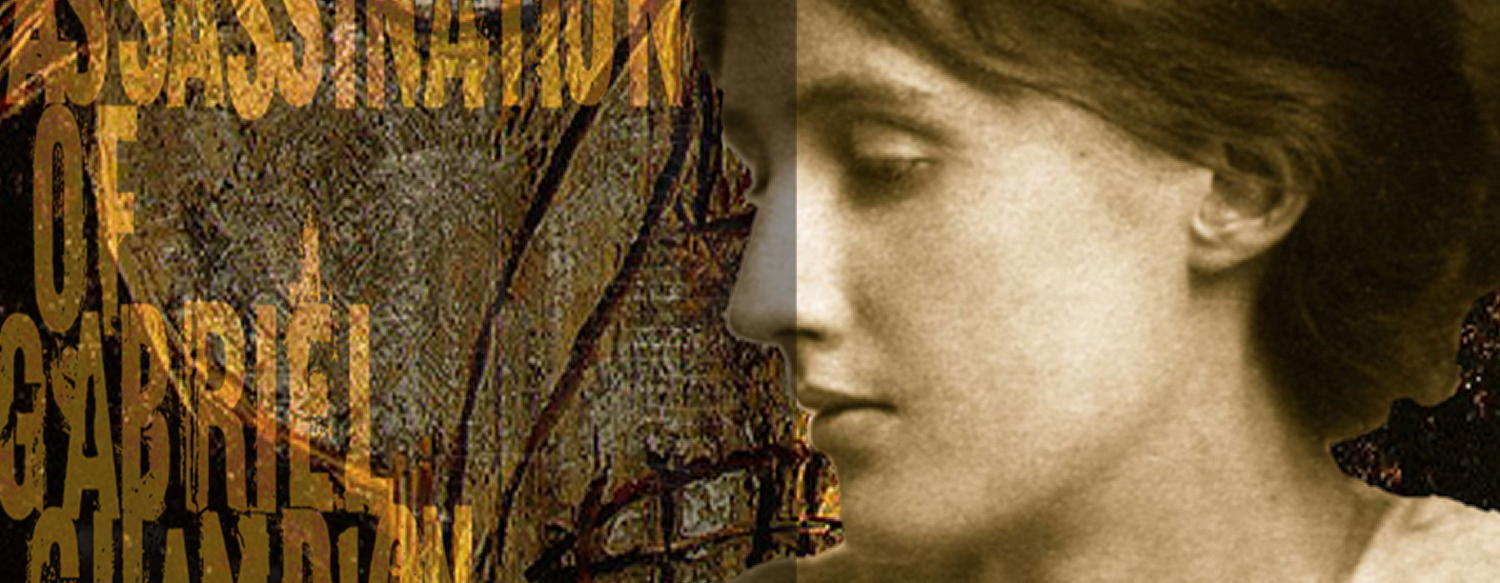
Nearly twenty years ago, I was properly slapped and mesmerized by a quote of Virginia Woolf’s:
“Who can pen when he is bored?  The minds of leisure only can be trite.” 

What I had no notion of, at the time, was how pivotal that idea would end up being in the writing of my newly released novel, THE ASSASSINATION OF GABRIEL CHAMPION.

I’ve spent the greater part of my life being an artist (a musician by trade) and constantly asking the questions:  What compels us?  What do we do it for?  And to what lengths are we willing to go to fuel it?  This kernel became the very seed of my story, a modernist tale set in Los Angeles and Paris at the end of the last century.

Exploring themes of violence and redemption, and an ode, however dark and sooty, to artists, THE ASSASSINATION OF GABRIEL CHAMPION ultimately asks its own question: What can we forgive?

During the first-draft stage, I spent two summers in Paris, soaking up the city that turned out to be the featured character in the last half of the book. Not only did I fall in love with Paris, but it maintains a mystical connection for me, and a torrid love affair, that I continue to this day.  Make no mistake, however; I’m an L.A. girl, born, raised and still residing.  And so the heart of the book is the City of Angels.

One of my fondest memories of this extraordinary odyssey was the enthusiasm of my beloved stepfather, Fred Hicks, no longer with us, who so fell in love with one of the book’s characters that he would engage in vigorous arguments with me over how I should resolve said character’s life. I can think of no greater example of pure love and authentic moral support. And my only real regret is that it took me so long to nurse the book into its rightful being, and finally get it published, that he isn’t around to see it.

I have lived with these characters longer than most marriages. They are inside of me, in my very blood, and I am ecstatic at the thought of finally letting them walk out into the world and introduce themselves. And perhaps even to inspire a dialogue about art and the compulsion of artists.

Years ago, shortly after discovering the Woolf quote that would end up changing my life, I wrote a poem directly inspired by it.  You might even say it’s a precursor to CHAMPION.

*
*
*

If I have never died

felt the burning on tips of my young

fingers to scorch a tender ache

I cannot write about it

If I have never killed

to cease the living of a truth untold

or scorned the womb that held me

I cannot dance it on a stage

If I have never felt

my belly swell with the hunger about which

I have only read

if I have never embraced hate

if I have never lost my mind

to yield to the brilliant

because I sowed my seed on fertile ground

I cannot paint it on a wall

Nor can I sing it

to my artist colleagues who

have all tried suicide once or twice

because they wanted to write about it

*
*
*

Thanks, dear Virginia, for planting a furious seed in my brain that has fueled me as an artist ever since.


Angela Carole Brown is the author of three published books, The Assassination of Gabriel Champion, The Kidney Journals: Memoirs of a Desperate Lifesaver, and Trading Fours, and has produced several albums of music and a yoga/mindfulness CD.   Bindi Girl Chronicles is her writing blog.   Follow her on Twitter, Facebook, Instagram & YouTube.