Let Us Never Forget, But Be Transformed

It has been 50 years since Dr. Martin Luther King’s famous 1963 “I Have A Dream” speech. Marches and celebrations of the anniversary started over the weekend and culminated today when President Barack Obama commemorated the occasion, standing in the same spot at the Lincoln Memorial, from where Dr. King delivered his words on 8/28/63. Churches and groups were asked to ring their bells at 3:00pm EST, marking the exact time Dr. King spoke.

Above is a track I have loved forever. Drummer Max Roach underscoring King’s speech.  The duet of two legends.  Breathtaking.

And below is a track of mine, recorded many years ago, a photo tribute to those who have fought for, and championed, the rights, freedoms, and protection of others.  A hero’s parade.

Let us never forget, but be transformed.  Do not leave this earth a parent, without having imparted this history to your children.

 http://youtu.be/-MAR7pHgWac


Angela Carole Brown is the author of three published books, The Assassination of Gabriel Champion, The Kidney Journals: Memoirs of a Desperate Lifesaver, and Trading Fours, and has produced several albums of music and a yoga/mindfulness CD.   Bindi Girl Chronicles is her writing blog.   Follow her on Twitter, Facebook, Instagram & YouTube.
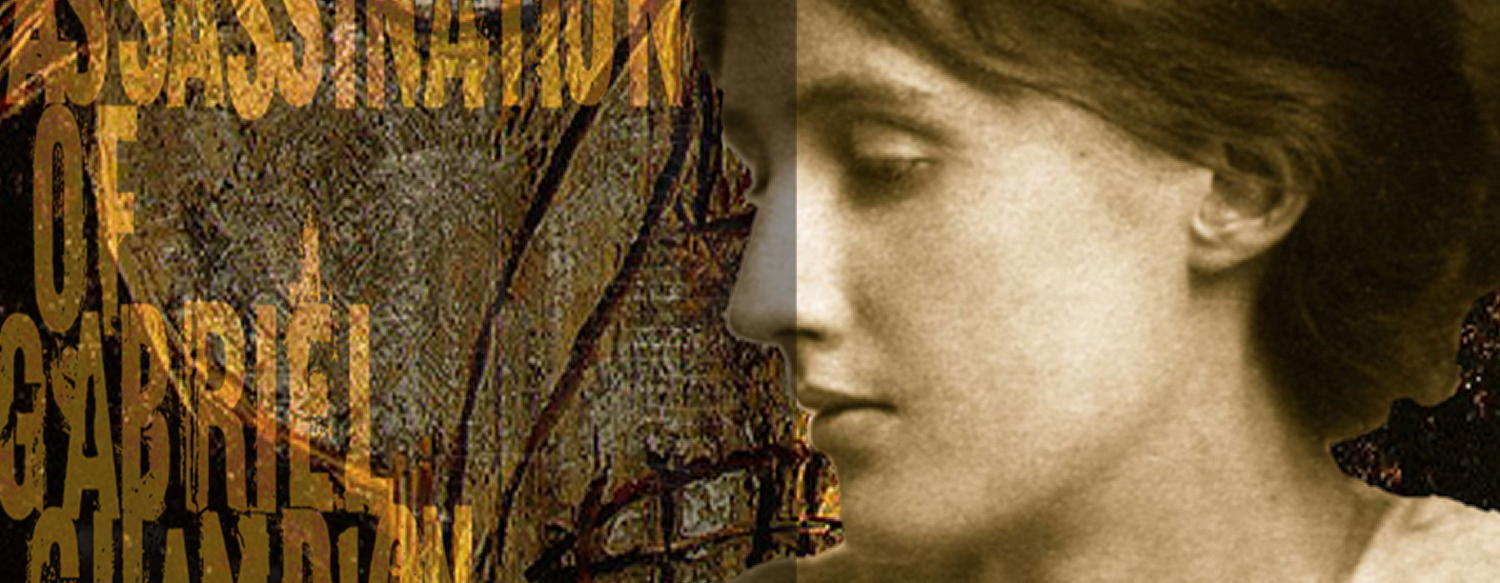
Dear Virginia

HauntedVirginiaWoolf

Nearly twenty years ago, I was properly slapped and mesmerized by a quote of Virginia Woolf’s:
“Who can pen when he is bored?  The minds of leisure only can be trite.” 

What I had no notion of, at the time, was how pivotal that idea would end up being in the writing of my newly released novel, THE ASSASSINATION OF GABRIEL CHAMPION.

I’ve spent the greater part of my life being an artist (a musician by trade) and constantly asking the questions:  What compels us?  What do we do it for?  And to what lengths are we willing to go to fuel it?  This kernel became the very seed of my story, a modernist tale set in Los Angeles and Paris at the end of the last century.

Exploring themes of violence and redemption, and an ode, however dark and sooty, to artists, THE ASSASSINATION OF GABRIEL CHAMPION ultimately asks its own question: What can we forgive?

During the first-draft stage, I spent two summers in Paris, soaking up the city that turned out to be the featured character in the last half of the book. Not only did I fall in love with Paris, but it maintains a mystical connection for me, and a torrid love affair, that I continue to this day.  Make no mistake, however; I’m an L.A. girl, born, raised and still residing.  And so the heart of the book is the City of Angels.

One of my fondest memories of this extraordinary odyssey was the enthusiasm of my beloved stepfather, Fred Hicks, no longer with us, who so fell in love with one of the book’s characters that he would engage in vigorous arguments with me over how I should resolve said character’s life. I can think of no greater example of pure love and authentic moral support. And my only real regret is that it took me so long to nurse the book into its rightful being, and finally get it published, that he isn’t around to see it.

I have lived with these characters longer than most marriages. They are inside of me, in my very blood, and I am ecstatic at the thought of finally letting them walk out into the world and introduce themselves. And perhaps even to inspire a dialogue about art and the compulsion of artists.

Years ago, shortly after discovering the Woolf quote that would end up changing my life, I wrote a poem directly inspired by it.  You might even say it’s a precursor to CHAMPION.

*
*
*

If I have never died

felt the burning on tips of my young

fingers to scorch a tender ache

I cannot write about it

If I have never killed

to cease the living of a truth untold

or scorned the womb that held me

I cannot dance it on a stage

If I have never felt

my belly swell with the hunger about which

I have only read

if I have never embraced hate

if I have never lost my mind

to yield to the brilliant

because I sowed my seed on fertile ground

I cannot paint it on a wall

Nor can I sing it

to my artist colleagues who

have all tried suicide once or twice

because they wanted to write about it

*
*
*

Thanks, dear Virginia, for planting a furious seed in my brain that has fueled me as an artist ever since.


Angela Carole Brown is the author of three published books, The Assassination of Gabriel Champion, The Kidney Journals: Memoirs of a Desperate Lifesaver, and Trading Fours, and has produced several albums of music and a yoga/mindfulness CD.   Bindi Girl Chronicles is her writing blog.   Follow her on Twitter, Facebook, Instagram & YouTube.

Occupy LA : A Short Film

I’m a lover of words, and a writer of words.  But sometimes pictures are all the words you need.  I shot this with my crappy camera.  Turns out some gorgeous music (by the inimitable Ken Rosser) and a profound subject matter are all it really takes to make a cool little moviette.   This is already a year and a half old, but I ran across it recently and discovered how proud of it I really am, so thought I’d resurrect it.   Besides, the movement still lives.


Angela Carole Brown is the author of three published books, The Assassination of Gabriel Champion, The Kidney Journals: Memoirs of a Desperate Lifesaver, and Trading Fours, and has produced several albums of music and a yoga/mindfulness CD.   Bindi Girl Chronicles is her writing blog.   Follow her on Twitter, Facebook, Instagram & YouTube.
 

The Damsel Culture

http://www.vuni.net - digital art

So, as I was on my way out the door this morning for my daily walk, I decided to do a different route, for interest’s sake, and walked past a kidney care center that I’ve seen many times, but haven’t paid much attention to, ever since I moved into the neighborhood.  Today I decided to stop in and inquire about their services, since as a kidney donor I need to do annual blood and urine tests to make sure all is in working order.  I have a primary care physician, but he’s quite a drive away, and I thought how cool it might be to have at least this part of my life be right around the corner.

When I walked in the front door, which is merely feet from the sidewalk on the very busy major thoroughfare of Devonshire Boulevard, I was instantly hit with a room filled with very sick people all hooked up to dialysis machines.  Feet from the street.  It so startled me to be that un-buffered, to not, instead, walk into an office or lobby or receptionist’s desk first, before entering the League of Great Sickness.  Because of my experience with the transplant, I’ve grown accustomed to that environment, so I wasn’t made uncomfortable; it merely startled me.  And it was at that moment that I pondered the strangeness of my reaction.  And the buffered culture we live in.

Everything is buffered for us.  From waiting rooms and front desks that – ordinarily – shield us from discomfort until we’re ready and geared to walk through certain doors, to signs at amusement parks that warn about possible vomiting or nausea if we get on that roller coaster.

And it instantly took me back to a poetry and prose reading I attended years ago at this wonderfully bohemian coffee house in Glendale, and the eye-opening lesson I’d learned that night.  I had signed up to read, had been in the midst of writing the book that incidentally has just come out (but this isn’t a plug, no way, I wouldn’t do that here … The Assassination of Gabriel Champion on Amazon … ), and had decided to read a passage I’d just finished working on, which included a rather graphic bit of violence.

After I read, I got some really great feedback which assured me I was on the right path with my writing.  And then this couple came up to me, a husband and wife, and proceeded, as delicately as they could, to inform me that the both of them, at an earlier point in their lives, had been the victims of violence similar to the one in my passage, and that while they appreciated my writing, and the earnestness of its content, they really wished I had been sensitive enough to warn the audience ahead of time that this reading would contain some graphic scenes, because they were unprepared to listen to something like that, and would’ve elected to step outside.

“We didn’t want to walk out on you in the middle of your reading.  We actually do believe in being courteous and respectful.  We just kind of wish you had been as courteous and respectful.”

I had no defense or comeback.  They were right.  I didn’t know who was in my audience, or what someone’s background might’ve held.   This couple certainly wasn’t asking me to censor anything, or to refrain from reading, or anything resembling a challenge to my freedom of speech and expression.  They’d simply requested a warning, so that they could elect whether or not to listen.  Perfectly reasonable.

I’ve never forgotten that, and because of that experience, so many years ago now, it is my absolute practice any time I’ve ever included a passage from one of my books on my website, or on any other public forum, and which may contain violence, sex, or strong language, to always include a disclaimer at the beginning of the passage.  Of course, no such disclaimer is ever necessary for the books themselves.  You’re a free agent.  If you elect to pick up my/anyone’s book, then it’s your responsibility to read what the book’s about on the back cover, and decide for yourself if you want to dive in.  But as for excerpts that appear anywhere publicly, if the passage contains strong content, I let people know.  I’ve subscribed to that practice ever since that night of the kind, respectful, fragile couple who schooled me.

Today, as I ruminate on our buffering society, and our need to be cocooned from difficulty and discomfort, I question if that’s what’s best for us.  Merely question.  This thought is all of an hour old, and I’m still processing it even as I’m typing this.  No judgments have been handed down yet.

But is it better that we be “protected” from reality; sickness and death, the scariness of roller coasters, or the contents of a book?  Or might it actually serve us better to be thrust headlong into that great jolt of life in all of its layers of beauty and ugliness and bliss and pain?

We live in a more frightened society today than we did years ago.  I don’t know, for example, a single parent who would allow their small children out alone on Halloween today, yet when I was a kid our parents almost never accompanied us.  We were free to roam the neighborhood, and everyone knew and trusted the neighborhood.  That’s not our reality today.  I realize it, and I respect it.  But I can’t honestly say whether I believe we’re a more violent culture today than a generation ago (I seriously doubt it), or if we’ve merely become pampered by a society whose principle commercial agenda is the selling of ease, convenience, instant gratification, and comfort.  And the fierce protection of our rights to never let our precious feet touch the dirty ground.  And fear.  Our society sells fear.

Dare I extend that idea to include the insidious sway of the self-help culture, which insists that we “fake it till we make it”?  And I actually feel a bit traitorous for even saying that, because I’m the biggest digester of self-help lit of anyone out there.  You should see what books are in my purse right now.  But that’s exactly why I know this to be true.  Even memoirs are almost never about brave self-reveals any longer, being able to lay your own self-discovered flaws on the table, and merely from doing so, transforming them, for yourself and your reader.  Which is incredibly powerful.

The self-help dictum says NO.  We must never admit fear, jealousy, rage, pettiness.   We must always be about self-promotion.  I can’t tell you how many times I’ve been “corrected” and reprimanded because I’ve dared to share my flaws in my insight-writing.  The intention is always well-meaning; the person is clearly in my corner.  But it makes me crazy nonetheless, because I can assure anyone out there that the sharing of those flaws has an intention, and is usually accompanied by an epiphany that makes it obvious I’m aware of its injury to me; that I am, just by writing about it, already in the throes of moving away from it, and toward something more evolved.  There are those who just can’t allow you to be flawed in public.  Because it might make them have to look at themselves.

The self-help movement was never supposed to be about anesthetization.  It grew out of Eastern thought:  Buddhism, the Yoga Sutras, the Tao, etc.  But it has become something very pop/pulp indeed.  The above-mentioned spiritual disciplines (my beloved gang!) never advocated denial.  We don’t transform from our weakness and flaw and condition just by magically denying it, despite what The Secret promises.  It takes hard work.  And the hardest part of the work is FACING.  Not being buffered by the warm-fuzzies.

And on that thought, as my dear friend Chokae Kalekoa likes to playfully say (with a rolled neck of course):  “Namaste, Bitches!”

Did I really need protection from witnessing the patients hooked up to dialysis as I walked through that door this morning because Blanche DuBois couldn’t hold a candle to my delicate sensibilities?  Should we be cultivating a world of Blanches?  Or would we be better served by throwing ourselves into the water, as we do children when we’re teaching them to swim, because there’s nothing that steels our spine like feeling that great jolt of life?   To remind us that we ARE alive?

I guess I clearly HAVE taken a position, after all.  And me!  I’m a coward!  A cautious, hesitant, worrisome coward, who cries easily, and can NOT watch those Sarah-McLachlan-underscored commercials about animal cruelty.  I’m almost always afraid of leaping, of being yanked out of my comfort zone.  But I also recognize the incredible power and radiant beauty and ridiculous boundlessness of those who DO know how, and are brazen.  I am envious of them.

One of my favorite quotes (you all know it), by Jack Kerouac, speaks to that very kind of human:

“The only people for me are the mad ones, the ones who are mad to live, mad to talk, mad to be saved, desirous of everything at the same time, the ones who never yawn or say a commonplace thing, but burn, burn, burn like fabulous yellow roman candles exploding like spiders across the stars.”

They’re the only ones for me too, Mr. Kerouac.

Namaste, Bitches!


Angela Carole Brown is the author of three published books, The Assassination of Gabriel Champion, The Kidney Journals: Memoirs of a Desperate Lifesaver, and Trading Fours, and has produced several albums of music and a yoga/mindfulness CD.   Bindi Girl Chronicles is her writing blog.   Follow her on Twitter, Facebook, Instagram & YouTube.

She’s a “Literary” Writer (Noted With a Wink In Her Eye and Quote Signs Made With Her Fingers)

LIteraryWriter

Are our heads up our own asses if we call what we write “literary fiction?”

As writers hoping to sustain a living in the business, the idea of genres, of understanding genres, and knowing how to categorize what we write in terms of genres, we’re all, at some point, faced with the question: “what genre is your work?”

Literary Fiction, I’ve recently come to learn, is one of those categorizations that’s become a bit controversial.  Apparently, claiming such as your genre lends itself to a kind of pompous self-importance.

I’ve always called myself a writer of Literary Fiction, because the genre, as I’ve understood it, was not about the quality of a work, but about very specific components that had to be in place, versus other components that defined Genre or General Fiction.

My understanding of Literary Fiction was that its primary focus was on development of character, and the creation of complex inner stories that fuel the motives and behavior of the characters.  That plot is almost anecdotal (versus being the entire focal engine of Genre Fiction), serving instead merely to uncover and examine larger, more introspective, universal themes.

The film critic Terrence Rafferty recently noted that “literary fiction, by its nature, allows itself to dawdle, to linger on stray beauties even at the risk of losing its way.” [1]

It’s a nice turn of phrase (even being one of those stray beauties I like to linger on).  But I suspect it’s not meant to be a compliment of the term.

What I’m now hearing (in this present universe of hashtags and trends, where the average use-by date is usually about a minute long) is that the “literary” delineation is, or should be, reserved for others to determine and classify about your writing, and is clearly meant to denote a work superior to other genres, or, even more disturbing to me, a work of great acclaim, which assumes that the only great writing out there is the stuff that’s moved significant numbers or that’s made its authors into celebrities.   Because in today’s world, “great acclaim” isn’t a critical theory term; it’s a popularity term.   It’s a definition that precludes that if you’re not well-known you don’t deserve the term.

#literaryfiction #headupyourownass #whodoyouthinkyouare

No matter – as I can go on an editorial tangent like nobody’s business – but this does seem to be the current definition of Literary Fiction.  Little did I know that all this time of writing works that have tried to explore ideas, create characters who aren’t easy to define, to like or hate or peg, to build layers, and assuming that there is a proper term for that brand of writing, that I really just had my head up my own ass (as is how I’ve actually heard it put about authors who have the nerve to claim the Literary genre).

As said before, my understanding of the term has never been about quality, but simply about a different set of criteria.   Genre fiction (as objectively as I understand it) is all about plot, and about the effective ability to keep a reader’s attention glued via certain well-calculated tricks, like a heart-thumping pace; short, taut chapters that offer cliff-hangers, therefore producing the temptation, after saying to oneself “I’ll only read to the end of this chapter, then I really need to get to sleep,” to keep going because that cliff-hanger just won’t leave your brain alone, and, after all, the next chapter is so short, so you’ll just do the one more, and then the next thing you know the sun has risen.  Oooooh, those devilish little tricks!   And if the plot is akin to a roller-coaster ride, or a complicated treasure map, with twists and turns that seem to come from nowhere, and leave a little tickle in your stomach, then you’ve really got yourself a fun read.  And in that environment, who cares about the back story and underbelly of Dick and Jane (it also doesn’t hurt if Dick and Jane are soap-opera hot)?  The conflict in Genre Fiction is always external, never internal.   The blockades and barriers to get past are always out there in the cruel world.   Because rooting around inside heart and mind and dark cave and intention and motive and dysfunction and baggage can never be taken at a roadrunner’s clip, and Genre Fiction cannot afford the luxury of dawdling and lingering.   All right, it wasn’t exactly objective, but I don’t think I’m off the mark.

Truthfully, a lot of fun reading can be had the way of Genre Fiction (I had an absolute ball reading The Da Vinci Code, because I surrendered the idea of rich characters that felt like real people, or turns of phrases that would arrest my heart, and I just strapped my seat belt on).   But what if “fun” isn’t exactly the experience you’re looking for in a book?  What if a deeper experience is what you’re looking for?  What if being split open, being jolted, having your own belief systems challenged and provoked…say…is what you’re looking for in a reading experience?

That’s a very different kind of book.   And as such, it SHOULD have its own category.

So, if Literary Fiction isn’t what that kind of book should be called, then what?

Here’s an even harder question (at least it’s a hard one for me):  Why should we, as writers, shy away from claiming our ability to create characters of depth and richness, to unleash social and moral provocations, to forge atmosphere and mood and memory, to create a relationship between reader and work that is intimate and profound?

Hey, if you’re the only one who thinks your own writing accomplishes that, then the world of opinion will weed you out with its own (usually cruel) efforts.    There is no need for you (me, all of us) to feel unworthy of boldly staking your claim in the world of books, and relegating yourself, instead, to a genre that doesn’t really fit, out of some kind of false modesty.

That’s right.  We are straight up LITERARY gangsta.


*          *          *

  • Rafferty, Terrence (February 4, 2011). “Reluctant Seer,” New York Times  Sunday Book Review.


Angela Carole Brown is the author of three published books, The Assassination of Gabriel Champion, The Kidney Journals: Memoirs of a Desperate Lifesaver, and Trading Fours, and has produced several albums of music and a yoga/mindfulness CD.   Bindi Girl Chronicles is her writing blog.   Follow her on Twitter, Facebook, Instagram & YouTube.

The Assassination of Gabriel Champion

“His strokes are not strokes at all, but gashes in the flesh of this life.”

Nearly twenty years in the making, my new novel The Assassination of Gabriel Champion has been my absolute labor of love, to use an overused cliche.  Which I realize doesn’t bode well for my reputation as a writer, but whaddaya gonna do?  The truth is, there is no more appropriate description of the experience for me.  It is a modern fable of love and loss, of violence and redemption, set in the world of art and artists, that asks the question:  What can we forgive? 

*          *          *

Writer NONA CHILDE is in love with artists.  They are the very embodiment of all her romantic notions.  She has, in fact, chosen an artist as the protagonist of her novel, The Assassination of Gabriel Champion, which unfolds a tale as alluringly dark as a rain-drenched European night.  So when she meets DANIEL CROSS, a gifted painter who is teetering on the brink of Heathcliffian torment (an intoxicating contrivance in Nona’s mind), she is presented with the opportunity to finally complete the arc of a long-coveted torch song life.  What she isn’t prepared for is a real playing out of the scourge of an artist’s soul; one far darker than any she could conjure with a pen.

The relationship that ensues between the brooding Englishman artist and the passionate young American authoress thrusts them headlong into a kaleidoscope of violent mood and memory, of euphoric, obsessive, torrential love.  They begin to tear apart as irascibly as they are brought together, but not before involving one ARTHUR HUGHES DUFRESNE, a local poet with a devastating past who succeeds in complicating the tangle.


*          *          *


Here’s just a little sampling.  An amuse-bouche, if you will.

(excerpt)
It had become a culture so desensitized, so lacking in the keen recognition of nuance, that what was required any longer to stir someone’s soul was movement, noise, clangs and bangs, where news outlets were consigned to showing actual video footage of head-on collisions in order for the viewer to be impacted by the pronouncement of tragedy.  And where art had to stun (stir just wasn’t good enough anymore) by feats and stunts and concussion in order to be considered the legitimate New Art.  Bob Flanagan hammering a nail into his penis before a live audience at a “happening” was considered art by those for whom the criteria was, singularly, that the deed be undared by anyone else.

Flanagan had been a performance artist battling cystic fibrosis and exploring themes of pain threshold, and there was certainly validity in the idea of a coping mechanism being raised to an art by the very involvement of an audience, a reaction, an impact, and a relationship.  But the bottom line for Daniel was:  How do you sell that?

He suddenly realized that in this drunken instant he was thinking more like an art dealer than an artist, and he surprised himself that he had, in one swift indictment, reduced his entire impetus to paint to his ability to make a living from it. Never mind the idea of art that was authentically experiential, completely stripped of the possibility of the repeat generation of dollars dealt from one collector’s hands to another’s.  Commerce had always been the farthest down on Daniel’s list of reasons to create, yet today it seemed to be the first, instinctive weapon he drew in this invisible battle with an invisible foe, for his (a mere painter’s) rightful place.

The art world had been stricken with a bad case of the emperor’s new clothes, and the rest of the world was guileless and gullible, including Daniel, who had started to believe the buzz about his own work.  Maybe being just a painter was the gimmick assigned to Daniel by the critical circle.  And maybe in the end, he actually was starting to feel unworthy of the attention because, after all –– all he did was paint.
(end of excerpt)

Tell your friends.  🙂
http://www.amazon.com/The-Assassination-Gabriel-Champion-ebook/dp/B00CVCPLF4/ref=dp_kinw_strp_1

Angela Carole Brown is the author of three published books, The Assassination of Gabriel Champion, The Kidney Journals: Memoirs of a Desperate Lifesaver, and Trading Fours, and has produced several albums of music and a yoga/mindfulness CD.   Bindi Girl Chronicles is her writing blog.   Follow her on Twitter, Facebook, Instagram & YouTube.

Satori

Satori

I don’t know why this has struck me on the most lusciously overcast day we’ve seen yet this year, but a remembrance of one of the hottest days that last summer saw suddenly flit past my eyes, and I thought I’d share it here.  It was an especially hard day for me, as I futily tried to rid my brain of obsessive thoughts over a personal issue.  Here’s what happened (not the personal issue, which I’ll just keep personal, but the day in question).  I decided that going to see friends of mine who are in a band perform at a summer solstice fair in Santa Monica would be just the needed anesthetic for my flooded brain.

When I arrived at the beach, it was a gorgeous day in spite of the triple-digit heat, and everyone from every Venice/Santa Monica walk of life was out, and in their inimitably Bohemian form. My kind of folks. I traversed from where I’d parked my car about six blocks inland of Main Street, and found the stage where my friends would be playing.

And as the music began, and I found a nice shade spot on a nearby curb on which to sit, I began to catch myself, here and there, not listening to the music. The blue noise in my head was louder. So, I briefly moved away from the crowd and called a friend who lives in the neighborhood and had him meet me there, just to add to the party.

He showed up, and we sat together and clapped our hands and snapped our fingers, and “whoooo whoooo”d and whistled at the end of solos, and were happy to see each other. But I was still afflicted. What other tricks could I pull? What other pill could I pop?

And that’s when I realized that this music before me was being used by me as a tool for checking out. And it deserved to be heard for its own sake. Not as distraction from problems, where then its only task is to be noisy enough to drown out that other noise. For that matter, I could’ve found a nice landfill where sanitation trucks would loudly dump their refuse. Or just sat by the side of a freeway overpass and let the engines and car horns and screeches easily drown out the clutter in my head. But I chose music instead.

Something that is sacred and transformative. Something that is never noise. I whored it.

And just at the instant that I had this realization, I truly heard the music for the first time that day. And felt lifted. I even, at one point, felt my phone vibrate on my hip and I ignored it (something I simply never do) in favor of a magical moment between two guitar players that I just didn’t want to sacrifice. And then it was gone. Blue noise in the head back again. And as loud as ever.

I started to notice the people around me. A little boy, maybe 4 or 5, danced and twirled euphorically until his father swooped him up onto his shoulders and his mother suddenly slathered his little face with sun block. It took the kid by surprise, who expressed his great irritation in the form of tears, wails, and a furious wiping of his face. Until only seconds later, the annoying sun block was forgotten, and little tyke was euphoric in giggles and twirls once again. It made me smile, which turned into a laugh.

I noticed an older woman, maybe homeless, it was hard to tell, who found herself a chair in the hot sun, and sat for the entire two sets of music, never once moving to find shade, as everyone else was doing, and so completely focused on the music in front of her. And I wondered what key to enlightenment she had that I could not seem to find.

And in those moments of people-watching, I was once again tuned into the music. As if the music was the conduit to a sudden state of presence. To listening, and observing, and taking in every sensation, every smell, every sound, every judgment even. And embracing it all. The crazy man with the playhouse on his head, who played air drums right along with the real drummer on stage, was glorious to me. And I thought of the scene in the movie American Beauty where the video-wielding kid from next door shows his new girlfriend footage he’d taken of a piece of paper floating in the breeze, and how beautiful he found this thing that was really nothing. It is a statement about finding treasure in every cell of every thing.

And as my day progressed, I found myself in and out of this remarkable sense of true presence, of finding that treasure in every cell, interspersed with hits of my blues and my burdens, which are all about being chained to past and future, and recognized what Buddhists call satori, which is defined as a “brief flash of insight.” I was flashing all over the place. But could never seem to find what in aeronautics is called gimbal lock.

Can we really reach a point where we’re always in an uninterrupted state of true presence, never allowing our problems to sit in the brain and furiously try to work themselves out, as brains will do? Or if we can at least count on a few brief flashes here and there to periodically anchor us and remind us that everything has value for its own sake, and not just as tools for medicating our wounds, isn’t that enough?

And sure enough, on the ride home, I felt full. Full with a day of communing with friends, and hearing wonderful music, and eating great food, and laughing. And none of it made my problems go away. It just managed to put those problems in their proper place in my brain, instead of allowing them the indulgent, repressive center stage.

I heard music that day for its own sake, even if only for moments at a stretch. And I found great meaning in the littlest things, if only in brief flashes.

I’ll take it.


Angela Carole Brown is the author of three published books, The Assassination of Gabriel Champion, The Kidney Journals: Memoirs of a Desperate Lifesaver, and Trading Fours, and has produced several albums of music and a yoga/mindfulness CD.   Bindi Girl Chronicles is her writing blog.   Follow her on Twitter, Facebook, Instagram & YouTube.

The Big Purr : CD Review


Pasheen

I confess I have a particular weakness for female vocalists with low voices. It’s as if they are saying to a world that is enamored with high notes and prepubescent timbers, “tough shit.” And with a shrug of the shoulder and a gleam in the eye, they pull and tug at your groin with those low notes, rumble the rafters, and take you to places that only seem to exist in acid-washed film noir and lurid pulp novels. Pasheen is such a creature on her most recent jazz CD The Big Purr (it is tempting to suggest that the CD’s title is all about those low notes, but that’s awfully easy), and one suspects that she is clearly aware of the inevitable comparisons to sultry contraltos like Julie London, and so puts it right out there, as she does on the opening cut, So High, as if to say, “well, there’s Julie…and then there’s me.” Pasheen makes it clear that she won’t stand in anyone’s shadow, and then proceeds to blast the genre altogether with lyrics that are as playful and mischievous as they are seductive and alluring.

From the first sound one hears (the crackling of an old LP – remember those?) we are placed frankly and unapologetically in a world that could never be inhabited by the teeny-boppers who command the world’s current stage. There is wicked in every fiber of Pasheen’s voice. She is creating her world, song after song, layer after layer, paint stroke upon paint stroke, and welcoming us in, but with a “beware” sign. It’s an underground world. A world that moves at a stroll’s pace. A world of shadows and seduction. A world that almost doesn’t belong in today, but somehow equally in an era bygone and a tomorrow that waits patiently (read timelessly) until the bubble-gummers burn themselves out.

And then there’s that voice! It is textured and haunting, a lesson in the mastery of phrasing, a history rich with tales and battle scars and luscious liquored flavorings, always in impeccable control, if at moments purposely letting loose grace notes both feral and unrestrained, and with the fattest, sexiest vibrato I think I’ve ever heard. Most importantly, at least to this listener, the voice is rife with poignancy and pathos. And every bit of it works.

Pasheen seems happiest (in a lyric) when letting us know that she knows her environment, her fellow jazz players, the luminaries in the genre; and that while she most definitely celebrates them, she also takes her rightful place in the pantheon. Oh believe me, she belongs.

She has fun on cuts like Busy Man (“being a type-A over-achiever myself, I realize that I could end up in a 24-step program”). It’s a lyric that makes one chuckle, while all the time knowing full well that this Big Purr of a singer moves at a Type-A pace for NO ONE, but vamps by, daring you to come along. And so she creates contradictions that serve to remind us just how complex we human beings really are.

There is an underlying sadness in Vanity, a song about cosmetic surgery. What’s most compelling about this cut is Pasheen’s unwillingness to pick a side on the subject, but instead giving us a startling portrait of modern life’s arguably most pathological preoccupation, and that she even dares to broach such an internal-conflict topic within the jazz environment, a neighborhood, from a lyrical standpoint, that has usually been relegated to weepy love songs, clever Porter-esque turns of phrase, and comedic sexual innuendo. She dares to complicate the idiom.

If I seem to be harping a whole lot on lyric, it’s probably because I’m a vocalist too, and lyric means everything to us. But never for a minute think that the rest of the package is an afterthought. Strong melodic writing and a sophisticated harmonic environment puts these songs (more than half of which Pasheen composed or co-composed) squarely in a league with the most timeless of them.

Trumpeter Carl Saunders’ scatting, on his composition You’re So Cute, had me laughing in the jolliest way from pure joy at the fun he is obviously having, a trick that belongs exclusively and exuberantly to the jazz genre, and yet few do it well. I get the feeling this may be signature for Mr. Saunders, as he is given complete carte blanche on this cut, with Pasheen respectfully giving her colleague the floor. Takes balls to give the floor in that way, when it’s your album. But then Pasheen has a pair on her that, I dare say, rivals any of her male counterparts.

As evidenced in her tome to Billy Tipton. Her heart is practically breaking on the wonderfully odd and iconic song Cross Dress, leading us to consider a world so intolerant that it demands the Big Lie. It is equal parts shame-on-us reprimand and loving tribute to the many whose lives were relegated to the fringes. It is melancholic without ever moving into the territory of dirge-y sadness.

My favorite cut has to be the finale track, The Truth, composed by the Diva, herself, which paints a landscape of the Seek, the Search, the Path, and which suggests that this radiant singer has depth to spare, yet she keeps it light and fun: “Maybe god is a goddess in a strapless dress.” Frankly, I’m envisioning that goddess with shocking platinum hair.

She has the best of the best as her production and performance team: Co-producer Barry Coffing and engineer Talley Sherwood to start with, and a parade of some of the business’s top session players from L.A. and Houston, including celebrated woodwind player Bob Sheppard, who offers gorgeous warm-toned tenor solos on most of the tracks, and who, all, help to make every track strong and tight. Straight-ahead swing, crisp bossas, and ECM-esque rhythms create the bed for this body of work to lie on.

Pasheen straddles playfulness and pathos with equal aplomb on this recording of twelve stellar cuts, and celebrates the genre of jazz in such a unique Pasheen-only way, that one gets the feeling she loves rocking the boat of the comfortable, and shaking up folks’ worlds, all for the sake of a powerful musical moment.

Her liner notes include thank-you’s to animal rescuers and to our soldiers, which gives a clue into the passion and compassion at work in this beautiful songstress’ heart. But you won’t have had to read about it in the liner notes to feel it with every note sung.

You’ll find you need to hear The Big Purr again and again just to catch every finely layered nuance. It was a joy for this listener. Congratulations Diva!

And as always:
Create – even if you’re not an artist
Support artists – especially the independents
Live well – doesn’t take money to do it
And be whole

Pasheen:  http://www.reverbnation.com/pasheen


Angela Carole Brown is the author of three published books, The Assassination of Gabriel Champion, The Kidney Journals: Memoirs of a Desperate Lifesaver, and Trading Fours, and has produced several albums of music and a yoga/mindfulness CD.   Bindi Girl Chronicles is her writing blog.   Follow her on Twitter, Facebook, Instagram & YouTube.

At War with My Own: Race, Identity, and the Argument for Otherly

AlbinoBlackBoy

Be nobody’s darling… Be an outcast; be pleased to walk alone (Uncool)
Or line the crowded river beds with other impetuous fools.”
– Alice Walker


 This is my Defensive Manifesto.

Jazz (a distinctly African-American art form and hence providing great irony in a quandary I face) is the creation of a unique improvisational voice, of taking the chordal framework of a piece of music and moving around within it to explore other intervallic possibilities.  It is the assertion of an identity.

I am a musician by trade.  I am also a musician by the compulsion in my gut to assert a unique improvisational voice, and by doing so, unflinchingly state who I am.

As I stare this quandary down, one that has stared me down with a kind of bullying shoulder-nudge for most of my life, one that threatens my right to improvise, I am most profoundly reminded, and always, of a particular set of words from the writer and scholar W. E. Burghardt Du Bois, who writes of “a world which yields him no true self-consciousness, but only lets him see himself through the revelation of the other…of measuring one’s soul by the tape of a world that looks on in amused contempt and pity.” 1

He was writing, of course, in 1903, of the duality of Blacks in White America.

And yet, as his is the sole entry in my mind’s bibliography in this pondering of mine, this quandary I stare down, I cannot help but observe how on its ear this insight has, one hundred years later, been turned.

That we even see a new phenomenon (new only in the scope of American history; not so in the scope of my entire life) means that America has shifted, adjusted, reluctant and stubborn and slacken though it may be, to make room for its “co-worker in the kingdom of culture.” 2

And so, to stare this quandary down is, at least, a modern peculiarity that verifies a somewhat different world from the one about which Du Bois offers his dialogue.

Is it an improved world?  Or has it merely shifted its dynamic to locate and identify yet another group to be the newest scapegoat of contempt?

There are any numbers of African-Americans in this country who are viewed as living their lives largely “outside” of the Black experience.  They are considered a phenomenon to both Blacks and Whites (although perhaps less so in an era where White teenagers are more and more emulating, with a kind of hero-worship, the Black subculture of rap).

Because a good deal of my friends are White (though my closest ally and oldest, dearest sister-friend for close to forty years is African-American), and because many, though not all, of my romantic relationships have been interracial, I have often been shoved into that category.

And yet, for example, you could not have found a louder voice than mine, screaming at the top of my lungs in frenzy and celebration, the year (11 years ago now) Denzel Washington and Halle Berry swept the Oscars and made not only African-American history but simply history. I shook hips and Jesus-shouted, with a delirious euphoria and a sense of communal triumph, but also with a perfectly conscious goofiness, to the witness of the two White friends who were watching the ceremonies with me that day, that, “It’s Black People Day!  It’s Black People Day!”

Because there is a significant population of Whites in my life, there are those who surely wonder if I am suffering a kind of self-loathing. Those are the compassionate ones, the ones who may not understand my choices in life, who may suspect a pathological history, but love me just the same.  And then there are those who simply dismiss me, who deem me unworthy of being “among the folks.”

There is a club. And from it I have often been banished, like a leper, for fraternizing with Whites.

And yet that was me, on Oscar Day 2002, screaming as loudly as anyone who, in their day, may have screamed, “Say it loud, I’m black and I’m proud!”  Or those before them with, “We shall overcome!”

Those whose instincts are to banish do not know me, though they would believe otherwise.

And finally, after years of my own confusion and turmoil over the subject, of wondering, myself, why my instincts and alliances have been as they are, and eventually turning inward and doing the kind of deliberate self-examination and facing-the-wall spiritual work that I have now consciously done for the past several years, I have emerged with a light.  It is dim still, until it will one day flicker to its eventual fullness, and give me some measure of peace.  But I am on my way.  And for now, here is what I’ve concluded:

I grew up in an all-black suburb of Los Angeles (Compton, California) in the 1960’s-70‘s; in fact, probably never saw a Caucasian up close for the first few years of my life.  There was a time in my life when if a White person walked into my parents’ home (which eventually began to happen more and more frequently as my mother’s career in local politics and city government grew), I felt uncomfortable.  It was only natural; they were not a part of my inherent familiar.

I remember once having a crush on a little Hispanic boy (the only one in my neighborhood) in my fourth-grade class, but when asked by my best friend why I did not tell him I liked him, saying to her, “He’s Mexican!” as though I were being asked to commit a mortal sin.  Mine was not an anti-Mexican instinct or belief system; it was simply that the idea was completely foreign to anything I had known.

As childhood advanced, for reasons that I believe ultimately took me to art as my calling, I became the one who was known as otherly.  I marched to my own drummer, and my family affectionately called me the weird kid.  Just one example (a story I seem to write about repeatedly):  I once picked up a dead bird and brought it home.  It was so beautiful, unmarred even in its death, that I placed it in a Tupperware bowl and put it in my mother’s freezer.  When my parents (always great sports for my oddness) asked me why I was keeping it, I told them I planned on having it taxidermied some day.  And there it stayed for years, nestled between the rib-eyes and the popsicles.  I cannot honestly remember the eventual fate of my beautiful bird, but I had definitely set the mold for quirky, for better or for worse, much of which ended up being for worse, as childhood defiantly insists on an adherence to conformity. And no matter what I tried to do, consciously or otherwise, to blend in, I had to accept my fate that I would always be the brash dash of color in an otherwise gentle pastel.  Of course, this phenomenon exists in all childhoods, not just a Black one.  But the specific dynamics of my experiences would turn out to ring profoundly with race as the primary and insidious focus of my outcasting.

Spike Lee’s satirical film School Daze (1988) examines, with a scathing humor and not a small dose of tragic irony, one of the more lamentable skeletons in the Black culture’s closet (though we are certainly not the only ones): the racism within the race.  My childhood, being all Black and therefore racially insular, likewise, did not ring of nigger-calling from hateful whites, as an African-American from the South surely experienced his childhood, but instead was ripe with:

“Hey, Shine!”

“Hey, Blueberry!”

“Tar Baby!”

“Ink Spitter!”

“Yellow Banana!”

“Vanilla Head!”

“Look, y’all, she’s so bright, she’s practically white!”

… at each other.

The stunning reality in my childhood environment was that there was no shade any of us could safely be, free from the hysteria of people who simply did not wish to be Black at all (I examine this very phenomenon in my novel Voodoo Child).

Did I not want to be Black?

As a child growing up in an all-Black, lower-to-middle-class neighborhood, already brewing with gang rumblings and self-destruction (which always got displaced and misdirected out of a debilitating frustration to be simply accepted among one’s own), surrounded by drab factory communities, run-down storefronts, and barb-wired schools; the constantly reinforced ideas of my ugly nose and my dulled wool hair that stood on end and my given plight by a punishing God, and with nothing but affluent, pretty, White people and sparkly-clean-Negro-free realities depicted on my television set, the answer then was no.  I did not want to be Black.

I was also not alone, though the syndrome hardly created a support system.  We (those of us who agonized this) were overly burdened by the “two-ness” of which Du Bois speaks:  “One ever feels his two-ness –– an American, a Negro; two souls, two thoughts, two unreconciled strivings; two warring ideals in one dark body…” 3

Instead we coveted the much easier world inside of our TV sets.  And whether we did or did not recognize the disease at play or acknowledged the others of our brethren who suffered it, we made sure to keep it to ourselves.

Today my answer is unequivocally, “I would not wish to be from any other race or culture than what I am.”

And how this shift from my initial childhood images to what I feel absolute about today?

It was certainly not the sudden emergence in the late 60’s of the Black Power Movement.  Notions of automatic-weapon-wielding men in black berets only frightened me as a child.  My older sister’s involvement with the movement did somewhat entice and romance me for, in my little girl’s mind, the steeled, chest-spreading boldness with which she entered this exotic terrain.  In my mind’s eye, she was the agitator; I was the conformer.  I looked up to her, all the while feeling about her (the way God is viewed) that I could never aspire to her greatness, that I should not even dare think that I could, and instead comfortably regarded her, from my child’s distance, with awe and fear.

So what has caused the shift?

There is a kind of dizzying giddiness in me when a Nelson Mandela or a Martin Luther King Jr. make our front pages as great men, or have holidays established in their honor.  That giddiness surfaces when those for whom there is little, or no, historical precedence triumph (Halle and Denzel). That giddiness surfaces when a Toni Morrison wins the Nobel Prize.  When a Maya Angelou becomes the Poet Laureate of our United States.  When a Black man with a distinctly African surname becomes the President of these United States.  To be frank, their being Black has everything to do with my giddiness, a kind that is not quite the same when my non-Black heroes make their strides in the world.  And yet, for me, it has never been about the instinct to divide.  It is simply an inherent, blood-tinged, DNA-connected, gut instinct to celebrate my own.

It happens to us all, in some form or another. It comes with time. Our intolerance for silliness and our aging impatience with a fickle heart and a toxic energy to self-loathe tires us. And then we open our wizened eyes and recognize the wonders of our own, and that, as Du Bois put it, our “…blood has a message for the world.” 4

Today there is a different racial dynamic from that of my childhood, but not because the divisiveness is gone; it is simply that the divisiveness has been directed elsewhere.  Instead of trying any machinations possible not to be Black, it is now about testing our fellow brethren to see if they are being Black enough; if they merit entrée into The Club. There is a badge of honor that grew out of the Black Power Movement; an assertion-of-pride answer to a self-loathing that had been perpetuated from slavery clear through to the 1950’s.  But how is that badge of honor manifested today?  In a walk?  A talk?  A secret handshake?  A resolve to divide and separate all over again?  To repeat a bitter history, but this time with our own hands at the Devil’s wheel?

Historically there has always been a White culture to worry about, with no modern example more brazenly displayed than our eight-years-ago political reign, where the movement toward an anti-Middle-East and anti-Islam sentiment, by a decidedly Anglo West (never mind history) was being richly nourished.  But as far as my immediate day-to-day life is concerned, I worry about The Club; the ones who instinctively call me sister, even when they do not know me; yet snicker or roll their eyes, and hold me up to the most stringent of queries, checks, balances, and harsh sentencing when they learn that I speak or dress or wear my hair a certain way.

How many times in my adolescence, for example, that I was laughed at by my Black peers because I “talked White” is a number I demur to record.  That speaking with literacy was somehow something only Whites should claim, that there was a badge of honor in a bold and righteous illiteracy was a far deeper level of self-loathing than I could grasp.  I sort of understand it now among teens ––– it is the classic counter-culture rebellion ––– but it bothers me nonetheless that this is supposed to symbolize pride in our Blackness.  And of course, as a child, I was never articulate enough to put my rants into any intelligible form.  As a child who was outcast, I did not dare challenge the status quo.

It is what single-handedly turned me inward.  It may even be, as often comes with the process, what took me to art.

As a child growing up in the 60’s and 70’s, with marching parents and an activist sister, I was exposed to the racial atrocities that were saturating our American landscape, even though my own existence was quite insular.  So I fully expected yet another club to be banned from when my family moved to L.A.’s Westside and I started to go to school with Whites.  I was fourteen years old, and entering a whole new world.  I was suddenly in the literal minority, even though I had already felt like a minority in my previous all-Black environment.  Yet after the initial stages of discomfort with being outside of my familiar, eventually I came to discover something quite baffling: For the first time in my life I was being accepted –– quirks, otherliness, and all –– by my peers.  I was not the outsider who’d gotten beaten up after school.  No one called me High Yellow, or had ever heard the term.  No one cared that I liked dressing like a hippie boy, or that I equally loved the Jackson 5 and Jethro Tull.  No one cared whether my hair was straightened or in an afro, either which it might be, depending on my mood, or the day of the week.  And that was just it.  I was allowed, for the first time ever, to have a mood.  To exercise it.  And not be ostracized for it.  No one cared whether I was Black, White, or had three heads.

It was certainly not an adolescence that was free of adolescent conflict.  Girls were still aliens to boys and just coming into their own perplexing sexuality. Teen angst and brooding and emotional disturbances such as cutting and food issues, etc., were just as prominent struggles then as they are today.  Drugs were the floating specter of the tease of cool.  And yet none of that scared me in nearly the way that the haunted echoes of race scared me:  “Am I good enough, cool enough, and Black enough to be in The Club?”  And that was an enormous anvil off of my burdened chest.

And who knows the reasons that race was not an issue in my high school.  Perhaps it was because my mostly White environment was not the red-necked South, or the blue-blooded East Coast, but was instead an environment of West Coast Bohemian progressives, who were teaching their children love for their fellow man (regardless of culture, color, or class) and how to grow a righteous chronic in your own backyard.  Whatever the reason might’ve been, I was accepted for the first time in my life.  And during this most formative of teenhood years, the hard-wiring of my comfort zone had begun to be established.

The greatest irony of our historical stamp of being the descendants of slaves is that the greatest weapon in our pocket has always been and will ultimately be our education, our progressive ideals, our compassion, our shaman’s spirit (as were Martin’s and Malcolm’s), and our rising above an insidious and dangerous piousness: and yet, as a people, we have instead, by and large, developed into a culture of conservatism, fundamentalism, intolerance, and fear.

Take the phenomenon known as “the Down Low,” a reference to the syndrome of African-American men leading seemingly straight lives, complete with the nuclear family, who do not consider themselves gay, or even bi-sexual, yet have sex with men, in a kind of secret, double life, and about which the sole concern in the community seems to be the potential for exposing their unwitting wives to AIDS.  I was profoundly disheartened when I saw the Tyler Perry movie For Colored Girls based on the brilliant choreo-poem by Ntozake Shange (though some of the narrative was someone else’s addition to the text and, frankly, paled next to Shange’s words in every sense), and a storyline that was not Shange’s portrayed this phenomenon, making the wife the singular object of tragedy, and the husband, he who has been caught in the “crime,” demonized.  (I have my own theories about why such a scene would be added to this piece, but that’s a thought for another day.)

And though every culture surely entertains this syndrome, it seems to be epidemic in the African-American community, and it has single-handedly to do with the decidedly cultural intolerance of homosexuality, which is also epidemic, though this is often denied with a scholarly rhetoric.  Make no mistake.  It is epidemic.  The emasculation of the Black male in White America is a theme that has been examined, and examined again, the stuff of forums; and somewhere in that massive psychological tapestry lies the great hysterical rejection of the gay man; the threat, in many minds, to an already disadvantaged fight.  It is, tragically, an uninformed association.  And so these men, feeling oppressed by the possibility of being ostracized by their own community, and victims to a fear and loathing, even violence, of and toward their sexuality, are forced underground.  Or they proudly claim their stamp, and are subsequently banished from, or tormented by, their community.

I, too, feel concern for these wives, because they have been a statistic for this terrible plight of AIDS.  But even more profoundly, they have been duped.  And I maintain that the fault lies more in an unbending and pious society than it does in these women’s husbands (that would’ve been an angle worth examining in the Perry movie; an opportunity missed because the belief system is still deeply broken).  And so my greatest compassion is for the men, themselves, who live every day of their lives trying to be Black AND individuals.  Free of judgment.  Accepted.  Even (dare I ask it?) celebrated.  Allowed to live in peace.  And honestly.

The more I have soul-searched my own issues with race, and my sense of perplexing identity as an African-American (consider the fact that from moment to moment I switch my terminology from African-American to Black and back again), the more I have come to realize that my own comfort level has been continually tested my whole life because of a cultural tendency for a self-righteous judgment of anything that does not spell a very specifically-defined, and decidedly testosterone-driven, “Black experience.”

Because, in high school, I had White friends and was involved in the “white” preoccupations of drama, ballet, and debate (this was literally stated to me once), I was shunned by members of my predominantly White school’s Black Students Union, the joining of which, when I had begun school there, was the very first step (not the drama club, or the debate team, but the B.S.U.) that I had taken toward an attempt at socialization.

Could no one see the irony here?

Why must being Black be the badge we wear on our chests, far above shouting our manhood, or our womanhood, or our alliance to Christ, or Buddha, or Muhammad, or our efforts to be a compassionate human being?

Let us go back to the anecdote with which I opened this thought.  The year is 2002, a history-making year for African-Americans and the Oscars.  And I am ecstatic with a kind of stupored glee that Halle Berry is the first African-American woman to win in the Best Actress category, and that Denzel Washington is the first African-American man to be a multiple Oscar winner, and that Oprah Winfrey is honored with a special award, and that I, a Black person perpetually suspected of loathing her own race, am dizzied by a moment in history none of us could have imagined in the roiling civil-rights 60’s, or the oppressive Jim Crow South, or the dehumanizing age of slavery.   As a Black woman and a former actor, I had some interest in the dialogue that was bound to ensue in the weeks and months that followed.

To my disappointment, but not my surprise, African-Americans came out in droves vilifying the award proceedings, the movies these two actors won their awards for, and the actors themselves.  Many waxed provocatively enough on what was being called a Pyrrhic victory in article after article, with titles such as “Cake Walk” and “The Minstrel Show,” et al.  So sage were some of these insights, in fact (example: the proliferation of “ghettotainment,” 5  which I painfully agree has become a kind of sociological pornography), that the failure to rise above being the victim to their own anger over a century of whitewash Oscar history allowed their vision to be compromised.  I understand that anger has been warranted.  I, too, am frustrated that in eighty-five years, where four acting awards per year are bestowed, [still to this day, though the number has certainly increased from 2002] only a tiny fraction of those have ever been given to African-Americans.  The statistics for Hispanics, Asians, etc., is equally disappointing.  But much of this anger has made it difficult for the angered to see beyond the agenda of Blacks & the Academy, to be able to recognize that their fight was ill-placed to aim it at the two actors who had won the top honors that year, or at the roles they had brought to life.

The problem with the argument was that the quagmire of Blacks & the Academy is far more insidious and threaded throughout a years-long, complex quilt of racism, politics, and commerce than these objections reflected.  Because African-Americans have never had a balanced representation of the full scope of portrayed humanity, it becomes understandably difficult to be accepting of characters that are gravely flawed, such as the ones portrayed that year by Washington (Training Day, 2001) and Berry (Monster’s Ball, 2001).  Yes, the concern is valid.  But the danger (and here comes the artist in me, fighting for the right to express freely the full spectrum of human experience) is that it also serves to lessen the legitimacy of the antagonist archetype.

It would be easy to shove the character Denzel Washington played into the glamorized, bling-dripping street hustler category that strengthens the pantheon of ghetto heroes, and by extension strengthens the argument, but I maintain that there is something much richer going on in this David and Goliath parable, with Washington’s character having lost his very soul and fighting like a mad dog to stay afloat and keep the fealty of his community.  Therein lies his conflict, and the wage of that sin is death.

Why should Washington not be allowed the freedom to build his body of work, by choosing to explore the darker natured antagonist, as any White actor would be allowed to do?  Should he never be allowed to portray the villainous Iago 6, in order to maintain the spun agenda of the Magical Negro?  And if the answer is yes, then Washington is being unfairly imprisoned by not being allowed to peel back the layers and find the subtle workings of a rich character, as is not only his privilege, as an actor, but his duty to do.  A Black man playing Iago is no more a sociological tragedy than a White man playing him.  In fact, I dare venture to offer that with the Black man’s history, a role like that brings with it a very specific poetic irony and poignant baggage that a White man playing him does not.  The power and beauty is in the exploration of the human condition in all of its many possible, limitless facets.

Halle Berry’s work in Monster’s Ball was called a sell-out by many African-Americans, and her character a whore.  I realize that I set myself up for even greater ridicule by daring to defend it.  I may walk alone, but I will do so with clarity.  Here was a character who was the wife of a Death Row inmate, who then tragically loses both husband and child, and finds solace in a character (actor Billy Bob Thornton) with demons and losses of his own.  Was her choice of suitors what made her a whore?  Or could it possibly have been a crucial examination of one’s moral conflict in finding comfort in “the enemy,” and the idea that judgment and principle, in a moment of devastation, often leads us to paradoxical choices, and that from that a kind of growth in both characters is possible.  Drama is not intended to be comfortable; it is meant to unleash just those very kinds of weird phenomena of human nature, and to examine why.

I am aware of the importance of being wary of sexual exploitation, especially in light of the historical baggage of the White-man/Black-woman dynamic (whenever the Rolling Stones’ Brown Sugar 7 has ever been called on a bandstand of which I am a part, I have infamously exercised civil disobedience by not participating; choruses of “brown sugar!” go on with one voice missing).  But the singular sex scene in this film, which has generated a kind of infamy in certain circles, contains nothing remotely erotic, titillating, or exploitive.  It is a pivotal moment about two people so desperately suffering and alone that they are clinging to life by a thread.  It is practically an exorcism of all that has been built up in both characters, after suffering the crucible of tragedies that each has suffered.  It is a scene that is as poignant as it is painful.  And only someone unschooled in the nuances of human suffering could possibly construe the moment as anything that would get audiences and film crews moist between the legs.

Artists are responsible for illuminating the human spirit.  But along the way, as they try their damnedest to do just that, they keep being accosted by the world’s lobbyists, who try to slip them a buck if they will plead a particular agenda in their next work.  In these two actors’ case, because they are African-American, that agenda is the uplift of their people.  A worthy agenda; it simply does not belong, as a bribe or a threat, in a man’s pocket; it has no place to insist that these artists wear the armbands of propaganda.  The way to uplift the race starts with a coming together of forces that will, and should, be diverse and full of many colors and shades and walks and talks and pathos and pathways.

I do understand the wariness of the threat of being degraded yet again in history.  It is an awareness, if not a wariness, from which we should never part.  But I also know that the enemy is rarely within and that these two African-Americans deserved the support of their own.  That there was a tepid-at-best united front that came out and gave two talented actors their due, after all of the dues they had already paid just by being Black in their industry, has often made me wonder if there is not a pointed agenda of keeping the fires burning between Black and White, and Black and Black, because, frankly, I think it has become such familiar terrain that it is a universe we are not really all that interested in upsetting.

That has been the fuel all along of this particular heartbreak.  I do not care about trying to win over supporters for Hollywood movies. I care about the freedom to make choices in one’s life that will be assured the support of one’s community.

I used to think that I had held onto this particular rant (still more than 10 years later) because I was once an actor who gave up out of frustration, and I am proud of those who did not, but I am now more inclined to believe that it is because this example of a perplexing and convoluted racial quagmire was merely a microcosm of the life that I, and many, have lived for years.  And as we walk through our lives in this present era of our first African-American leader of the free world, and the death of The King of Pop, much is sure to be further studied and revealed about this quagmire:  The Black community’s acceptance or rejection of the confounding state of Michael Jackson’s own personal sense of identity, and where one dares to tread on the memory of someone held up in literal worship; and the phenomenon of Barack Obama, who, during his first term, was pulled and tugged in so many hysterical racial directions, for the agenda of both Black and White, liberal and conservative (He’s Black! He’s bi-racial! He’s Muslim! He’s Christian!  He’s American!  He’s African! et al.).

I plan on keeping my eyes wide open during this ripe time, because my very own life is quite directly impacted by this fascinating preoccupation with labeling, compartmentalizing, and legitimizing.

As stated earlier, I am a musician in addition to being a writer; a singer and songwriter to be more specific.  One of the many gigs and projects that I’m involved in is that I front an orchestra as lead vocalist (a remarkable opportunity that has afforded me a challenging and radical chance to perform twelve-tone, dodecaphonic repertoires), and my participation, made worse by my exuberance toward the experience, actually caused the crinkled, suspicious eye of certain (certainly not all) African-American colleagues to turn my way, wondering what mischief I was up to.  This was very early on in my involvement.  It’s now been nearly 15 years in the orchestra, we’ve become somewhat of an L.A. institution, and I’ve largely learned to tune that energy out, if it even still hovers.  And while the orchestra has actually developed quite a following now of fellow musicians and composers (including some serious heavyweights in the industry), those particular colleagues have yet to come out, 15 years into this, to see and hear this musical experience. That saddens me.

I was the house singer in a plush Beverly Hills hotel lounge for more than two decades, with a lovely jazz trio, and on one occasion many years ago I had just finished singing, in succession, the standards Caravan, You’ve Changed, and Ain’t Misbehavin’.  In between songs, a petite but assured African-American woman approached me to make a request.  With a great chip that had become recognizable to me over the years, and apparently disappointed with my choice of repertoire, she assessed the room, deciding that, though this was a hotel lounge where delicate jazz standards were the call, something else was needed to get the place jumping, and promptly asked me if I sang “any Black music.”  It was quite obvious to anyone witnessing what she meant.  She wanted a little Marvin, a little Sly, maybe even a little Beyoncé or Kanye, something that would put a thump in the proceedings.  She wanted to turn this standards gig on Doheny Avenue into a house party.

More crucially, however, and here is where recognizing the nuances of human behavior come in quite handy, she wanted me to prove that I had it inside of me.  I read this stranger like a book, as I have become accustomed to these Random Black Testings.

You see, they can smell me.  I do not sport a certain mannerism.  Or I do not speak with a certain rhythm and lilt.  Or I laugh and chat on my breaks with the players in the band, who, depending on the day of the week, or the hit, might all be White, and who are unapologetically my friends.  And because I have come to fear these ambushes, which often seem to come at me like non-stop billiard balls, it is as if a switch is thrown to alert the tester that a possible Benedict Arnold is in the room and to get in gear.  And my fear is smelled.  And I am, therefore, prey.

In this particular case, I simply played naïve; partly out of an annoyance that she could not appreciate the musical offering that was being given to her, and partly to plead my case before the court that I was worthy, an instinct of mine that greatly bothers me.  I responded with: “Ma’am, actually Caravan was written by Duke Ellington, You’ve Changed was a huge hit for Billie Holiday, and Ain’t Misbehavin’ is classic Fats Waller. So I believe I’ve given you quite a bit of Black music.” It was equal parts, “Fuck you” and “See, I’m a good Black person;” a defensive move that succeeded only in tangling my brain.

This answer not only did not suffice, but she instantly recognized the salt in my retort (mercurial though it was) and decided that I had my great nerve, and had failed her test.  Her eyes promptly rolled, she returned to her table of girlfriends, and the group single-handedly let it be known in the room that I was a leper who could not deliver what any true sistah would.

I sing Marvin.  I sing Sly.  These legends live deeply in my bones.  I have spent the last two decades building a repertoire of some three-hundred cover songs, developed over the long years of being in this business, and from every musical walk of life.  But that there are, like an unmercifully revving engine, these constant tests to see if I am representing the folks, and often by complete strangers, begins to asphyxiate.

It is, frankly, crippling to have race be the engine that fuels every conversation, every thought, every pointed finger, every waking moment, and supersede every other adjective and community that also defines who I am.  In my case, those adjectives and communities include:  Artist, Buddhist, Democrat, Capricorn, O+ blood type, Type B personality, Woman, Feminist, Sister, Aunt, Daughter, and, yes, American of African descent.  The latter is merely one in a list of many that have shaped me.  And if my being a responsible citizen, a contributor to my society, an artist creating works that aim to enlighten, educate, and entertain, a dedicated friend and family member to the people who love me, a champion of rights for all, and a person who respects the earth, if all of these things are not enough to deem me a proud Black woman, worthy of her race, then what is?

Some find it an exceptional circumstance that, though living in my “white world,” my best friend for close to forty years happens to be African-American.  In a sea of pink faces, which was my high school experience, it is not especially odd that two brown faces would find each other and feel an automatic kinship.  What is perhaps odder is that she and I grew up in different neighborhoods, and yet the phenomenon of being shunned by our own had plagued us both.  She had come from similar history.  And it was this strange, but not so uncommon, syndrome that bonded us, far deeper and more intimate than our brown faces.  We have loved each other without the need to test each other’s Blackness.  The game of the Superior Negro was unnecessary to bond us.  And yet, in each other’s presence, we do not put on white faces, or bleach our souls, as Du Bois worried against.

On election night, November 4th, 2008, we spent the evening together with bottles of champagne waiting to be uncorked, as election results began to flood television screens.  When it was announced that Barack Obama had been elected president (a moment that arrived, sadly, long after my dear mother and stepfather, who had been Civil Rights activists, had departed this earth) my friend turned to me with tears in her eyes, and said, “This means I can now look my [6- year-old] son in the eye and tell him that, yes, he too can be president one day.  It is officially no longer merely a mythological dream.”

I will never forget that moment.  Not only the historical one, but the intimate one between two sisters of the soul.

She and I have always celebrated our own with a great fondness for the eccentricities of our people, the food of our people, the language of our people, the accomplishments of our people, the larger-than-life richness of our people.  And we have, over the years, grown even closer in the wake of that same community finding the need to harshly judge our choices in life.  We have hovered together in our outcastness.

To be frank, all of the African-Americans that are in my life, that I consider comrades in the truest, deepest sense of the word, are those who have experienced similar paths.  And I venture to claim that it is not any of our intentions to deny our heritage, or the people in it, but to find those among us who feel as we have felt, and come together for healing.  THAT is a true brother-sister-hood.

The people in my life (Black, White, and otherwise) are here because they have accepted the unique individual (for better or for worse) that I am.  And I refuse to keep a tally of how many are Black versus how many are White.  I do not care.  They create a welcoming environment for me.  They are good to me, and I do my best to be good to them.

And I will continue to cheer on the triumphs and victories of my African-American brethren, because it is in my very DNA to do so; just as I will continue to cheer on the triumphs and victories of the people in my life who are not Black, because the lessons of my spiritual practice, of loving ALL of mankind, demand it.

In exploring this phenomenon, I eventually came to realize that this war “with my own” that I have always fought has never been with my fellow African-Americans (the ones who have deemed me unworthy), because it is neither my place, nor in my power, to change anyone.  It is “with my own” two selves; the half that desperately wants to be unjudged and accepted, and the half that will always insist on being the brash dash of color in an otherwise gentle pastel.

Granted, it is a significantly different take on Du Bois’ theory of the African-American’s two-ness, but a profoundly explorative one nonetheless, and only proof of the complex layers of the syndrome that he had set down before us.  And therein, I think, lays the greatness in Harvard’s first African-American Ph.D. recipient.

And so to those, both Black and White, who worry, wonder, or simply find me an enigma, I offer this:  If you just absolutely must insist on being confused by my loopy musings of, “It’s Black People Day, it’s Black People Day!” while sitting in a room with White friends, so be it.  It only means that I must be the first person to ever come waltzing through your life who has insisted on marching to her own be-bopping drummer and on her right to improvise; who is a complex and paradoxical human being.  But I promise you, I will not be your last.

 *                    *                    *

Notes / Works Cited

1. 2.  3.  4Du Bois, W. E. B.; The Souls of Black Folk, by W. E. Burghardt Du Bois, Bantam Classics, originally published in 1903.

5. Kaplan, Erin Aubrey; “Cake Walk” by Erin Aubrey Kaplan, LA Weekly, March, 2001.

6. Shakespeare, William; The Tragedy of Othello, the Moor of Venice by William Shakespeare.

7.  Brown Sugar, by Mick Jagger of The Rolling Stones, is a song whose protagonist is the braggart slave master touting his midnight visits to the slave quarters and his inability to stay away.  There has been some debate about the meaning of the lyrics; according to the book Up and Down with the Rolling Stones by Tony Sanchez, the slavery and whipping is a double meaning for the perils of being “mastered” by Brown Heroin, or Brown Sugar.


Angela Carole Brown is the author of three published books, The Assassination of Gabriel Champion, The Kidney Journals: Memoirs of a Desperate Lifesaver, and Trading Fours, and has produced several albums of music and a yoga/mindfulness CD.   Bindi Girl Chronicles is her writing blog.   Follow her on Twitter, Facebook, Instagram & YouTube.

Goodbye, Mr. Ebert

Untitled-1

We lost a good egg this past week.

The thing about Roger Ebert is that he didn’t just tell you what he thought was good or bad, effective, or ineffective, powerful or weak.  He was respectful of the creative process.  He always provided insight and analysis of what worked or didn’t and WHY.  I think artists are mainly weary of critics not because they fear criticism, so much as it’s that criticism is usually just a mask for cruelty, vindictiveness, or simply some reviewer’s bad day.  Gone are the days when the art of critical analysis was gentlemanly.  Ah, it probably never was.  I get the feeling the gloves have been coming off since the beginning of time.  It’s just fun to always hearken back to a more idyllic time the older I get.  It makes young people insane, which entertains me greatly.  I also totally get my parents now.

But Roger Ebert was a reviewer who respectfully bothered to articulate what he felt did or didn’t work and why, which I think any artist worth his or her salt would be able to appreciate toward improving their craft, even if they would love being worshipped.  And who doesn’t?

In fact, this very argument – the validity of critical analysis in a culture – appears in my new novel The Assassination of Gabriel Champion, argued between characters who are all artists.  And the great coincidence, to me at least, as my book is just on the precipice of entering the world merely minutes after we’ve lost this icon, is that Mr. Ebert is actually mentioned in the passage.

I didn’t always agree with his reviews, but because of the reverence with which he regarded the creative process, my instincts were never to say, “bullshit!” as I certainly have with other critics.  It was always, “wow, that’s an interesting perspective.  I need to give that some thought,” or something along those lines, as talking to myself is usually significantly less coherent than that.

I venture to assert that artists would be much more willing to regard their own bad review if the landscape of critical review was actually about improving the state of a piece of work, or any future work by said artist, or just the general state of art, and not purely for the purpose and intention of shaming and embarrassing the artist, or even toward the more troubling motive of amassing a cheering squad, as the lions ARE out for blood in our present culture.

And because of THAT reality, I also realize that that’s a lot to ask in a present society that embraces cruelty and public humiliation as entertainment (the current spate of talent competition shows always springs to mind).

I’m still rooting for a respectful society.  And only one of the many silent ways in which I choose to protest a rude society is to not watch those shows.

I realize that in a world of the bottom line, an artist’s livelihood really does require good reviews in order to move numbers, and thereby sustain one’s living.  And, of course, there is the absolute fact that no wants to believe their work is less than brilliant, and so our egos require it too.  But what their/our CRAFT requires, hungers for, and is sustained by, is the analysis (the praise AND the penalty) that helps us to evolve, grow, blossom, and eventually achieve mastery.

I dare say that Roger Ebert made a more than significant contribution to that very golden creative process in his time on this earth.  He made artists rise.

RIP Mr Ebert.

Angela Carole Brown is the author of three published books, The Assassination of Gabriel Champion, The Kidney Journals: Memoirs of a Desperate Lifesaver, and Trading Fours, and has produced several albums of music and a yoga/mindfulness CD.   Bindi Girl Chronicles is her writing blog.   Follow her on Twitter, Facebook, Instagram & YouTube.